
Who else is there and how they sell
The same opportunity can be excellent or suicidal depending on a single detail: who already sits there and in what mood. A theme with big but lazy leaders — who haven't launched anything in a year — is a different conversation from the same theme with two fast movers accelerating aggressively right now.
Your competitors tell you, without meaning to, almost everything: how many they are, how much ad pressure they apply, what messages they repeat, what their selling machines look like and — perhaps most usefully — what they tested and didn't keep.
What you'll be able to do after this chapter
- take the census of your theme: leaders, accelerators, new entrants — and what each profile means for you;
- read a competitor's arsenal from their page: ads, products, funnels, the latest move;
- extract from their funnels the category's standard — the minimum level your offer starts from.
The principle
Three profiles of competitive landscape, three different entry strategies:
- Inert leaders — big brands, long active, no recent moves: the best landscape for an intruder with clear differentiation; their inertia is your window.
- Aggressive fast movers — players scaling right now: strong validation of the theme, but also an expensive race; you enter only with an angle they don't cover (chapters 3 and 6 gave it to you — or didn't).
- New entrants in waves — many recently entered, no winner yet: a theme in its testing phase; you can wait a cycle to see who survives, or enter early accepting that many of the neighbours will disappear.
And at the level of the individual competitor, the most honest public signal remains longevity — the ads and funnels kept alive for months are the ones their owners have reasons to keep. RavenBI doesn't see anyone's sales; it sees what stays active, what it accumulates in estimated reach and in how many variants — and for prioritising your analysis, that's exactly what you need.
The workflow in RavenBI
- Open Brands for your market and filter mentally to your theme: who on the list plays in your chosen category or problem?
- Read the tabs: Leaders (who dominates), Fast movers (who's accelerating — the momentum column and "Latest move" show who launched ad waves in the last 30 days), New entrants (who's just come in). Place the theme in one of the three profiles above.
- Enter the page of each relevant competitor — five or six at most; the rest is noise. On the page: their ads (how many, since when, with what messages), products, funnels.
- Open their main funnel in the Funnel Radar: the page structure, the trust elements, the offer, the flagged weaknesses — and the change history, which tells you what they tested and what they kept.
- From two or three of the theme's long-running funnels, extract the category standard: which trust elements everyone has, which offer mechanics recur, which guarantees seem mandatory. Below that level you start with a handicap — it's the floor, not the target.
- Put the key competitors on the Watchlist: from the moment of the decision, their moves are your permanent context.
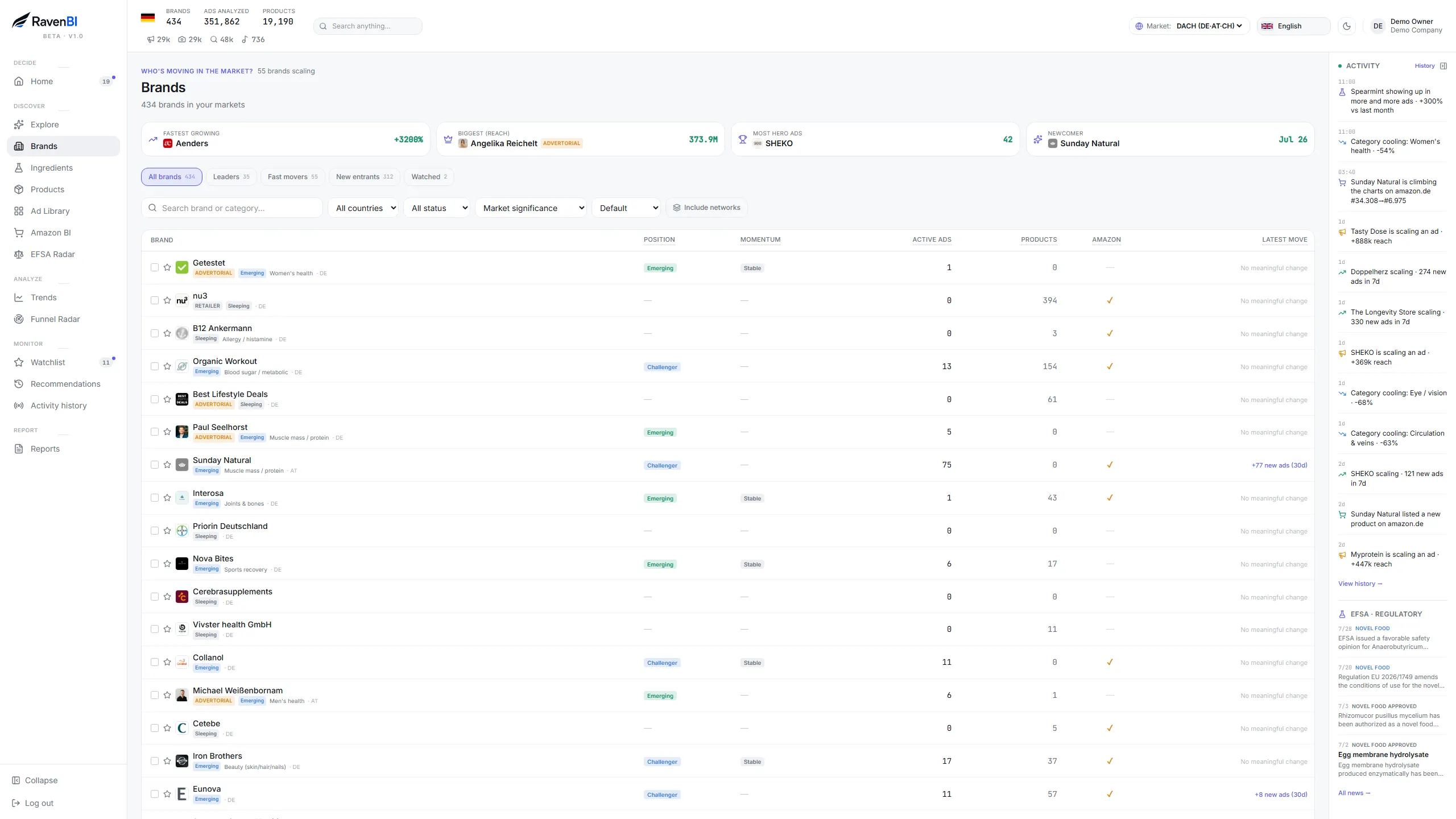
Who dominates, who accelerates, who's just entering — the census of the competition, with each one's latest move.
How to read the signals
- Few competitors, all inert = the classic window — but ask yourself why they're inert: sometimes they know something you don't yet.
- A single dominant fast mover = the market is closing around them; enter fast with a different angle, or not at all.
- Funnels unchanged for months, fed by long-running ads = machines that work — study their structure, don't copy their execution.
- A competitor who keeps changing offer and headline = still searching; the weaknesses flagged in the Funnel Radar show where their page is vulnerable — that's where you can build better.
The typical mistakes
- counting competitors instead of weighing them — ten dead brands are less frightening than one live fast mover;
- analysing the ad without the funnel — half the machine stays invisible that way;
- confusing the category standard with differentiation — the elements everyone has are the entry ticket, not the advantage;
- doing the census once — the landscape from decision day won't exist three months later; that's why step 6 isn't optional.
Exercise
Fill in the "competition" line on the sheet: the theme's profile (inert / fast movers / waves), the 3-5 key competitors with one sentence each on their arsenal, and the category standard extracted from their funnels — the list of elements your offer can't drop below.
Your sheet now has every line filled with signals, not impressions. Exactly one step remains: turning them into a decision — go, no-go or wait — and building the system that keeps watch after you decide. The final chapter.