
The go/no-go decision and the monitoring system
The most dangerous moment of the whole process is its very end. You've worked on an idea for chapters on end — and the invested work pushes towards "go" all by itself. Psychology calls it escalation of commitment; the warehouse full of stock calls it something else.
The antidote is to write the decision before taking it: a template that forces every signal to take a stand, in writing, with its date — so you can see, in black and white, whether the "go" comes from the data or from attachment.
What you'll be able to do after this chapter
- compress the eight chapters into a one-page decision with seven sections;
- tell apart the three verdicts — go, no-go, wait — and each one's triggers;
- build the monitoring that guards the window after the decision, without weekly manual research.
The principle
A good decision template has a single function: to make disagreement visible. Its sections:
- The hypothesis — one sentence: the product, for whom, with what differentiation;
- The pro signals — with each one's source and date (chapters 2-8 supplied them);
- The contra signals — mandatory; a page without contra signals means you didn't look, not that none exist;
- The confirming sources — how many of the three, and where the disagreement is, if any;
- The claim risk — what you're allowed to say, under what conditions, and what the specialist said (or will say);
- The competition risk — the landscape's profile and the fast movers to watch;
- The window and the next step — how long you estimate it stays open and what exactly the first action is.
And the honest boundary, written on the page: market data validates demand and competition. Margin, production costs, logistics and cash flow remain your internal calculation — no radar can validate them for you, and a market "go" with negative unit economics is still called a no-go.
The workflow in RavenBI
- Fill in the template from the sheet you've built throughout the guide — every section already has its material.
- Open Reports → Live Snapshot for your market: the week's moves, the scoreboard, the executive summary. It's the final context check — has anything major changed between chapter 2 and today? (Markets move while you analyse, too.)
- Make the decision. Go = the pro signals dominate, the contra are known and accepted, the claim has a path, the window is open. No-go = a key section is red and unfixable — and a documented no-go is a victory, not a failure: it's the stock you didn't bury. Wait = good signals, a single source, or a landscape mid-test — the case where monitoring becomes the plan itself.
- Whatever the verdict, arm the monitoring: put the ingredient, the formula, the category and the key competitors on the Watchlist. From this moment, the Home page shows you on every visit what changed since the last one — with what you follow brought to the front.
- Set Alerts for what you don't want to miss between visits, and let the weekly Live Snapshot (PDF or email) keep your review rhythm.
- Put the re-verdict in your calendar: at 30 days for "wait", at 90 for "no-go" — closed windows do sometimes reopen.
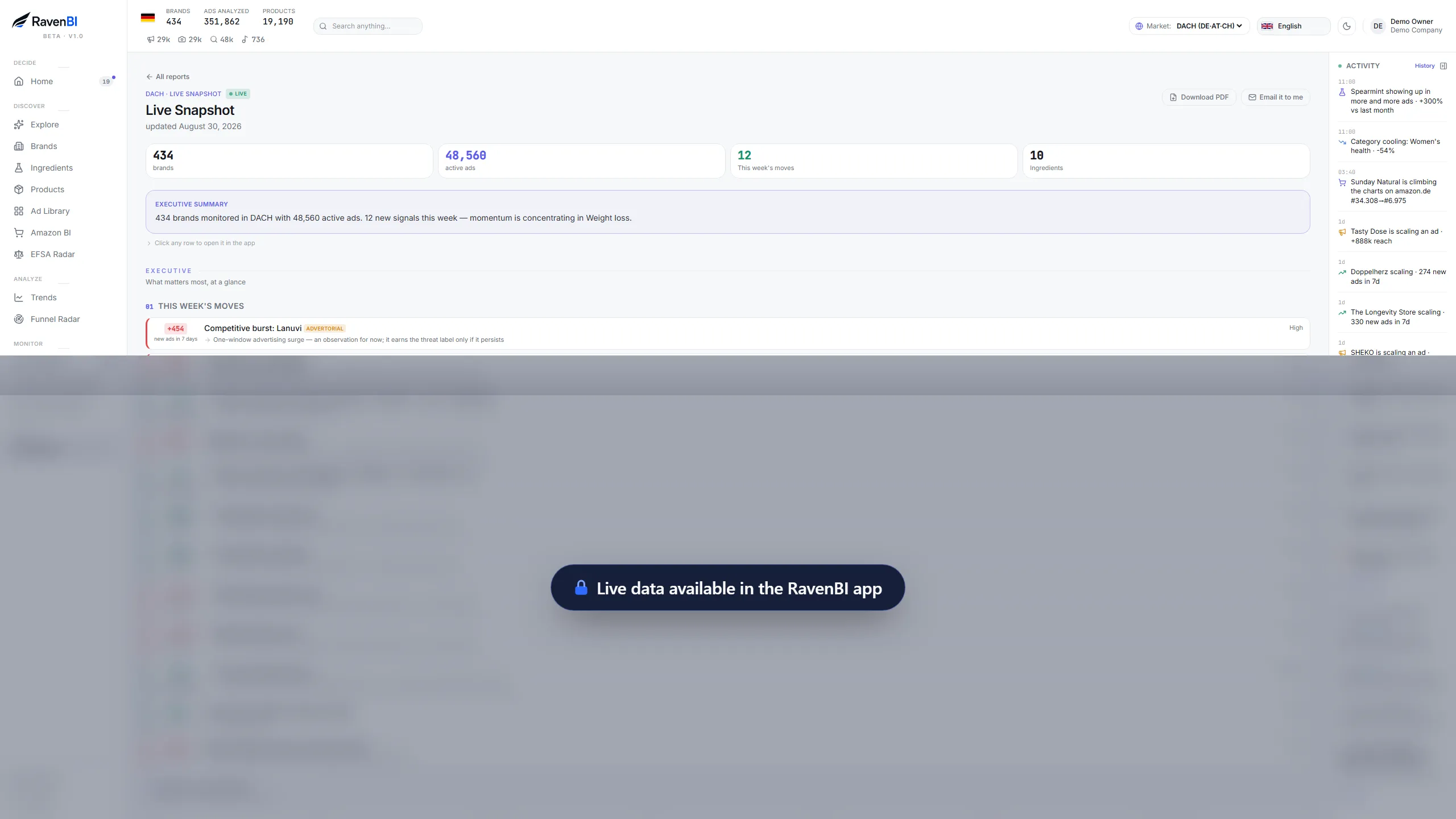
The week's moves, with their numbers — the final context check before the verdict, and the review rhythm after.
How to read the signals
- All sections green — go; and if that seems suspiciously clean, well done: reread section 3.
- One fixable red section (e.g. the claim demands reformulating the recipe) — not a no-go, an iteration: back to chapter 6.
- Good signals, a single source — "wait" with the Watchlist armed: if the second source confirms in the coming weeks, you learn it early — while acting is still cheap.
- A window narrowing during the analysis (new ads on the theme, a fast mover entering) — the signal that the analysis itself has a deadline: decide on what you have, or accept explicitly that this train has left.
The typical mistakes
- leaving the "contra signals" section empty — the most reliable predictor of unsellable stock;
- taking the market "go" for business validation — the honest boundary above exists for a reason;
- deciding and walking away — the window keeps moving after the decision, and today's "go" requires fresh confirmation at every investment stage;
- treating "no-go" as failure — the portfolio of documented no-gos is the experience that makes the next "go" better.
Exercise
Fill in the template completely for your candidate and give the verdict, dated. Then arm the monitoring from steps 4-5 — whatever the verdict. In 30 days, open Home and compare what changed against what you wrote: the cheapest calibration course for your own judgement you'll ever take.
That's the whole road: from "I have an idea" to a written decision, on signals checked across three sources, with the claim verified and the competition weighed — and with a system watching the window in your place. We didn't give you the list of opportunities, because nobody has it in advance: it rewrites itself weekly, in the application. The method, though, is now yours — open RavenBI and apply it to your market.
RavenBI PRO watches the supplement market for you — every ad, every funnel, every trend. From €149/month, cancel anytime.
See plans & pricing