
Look for whitespace in problems, audiences and formats
The reflex of every founder hunting an opportunity is to hunt an ingredient. As a first step, it's the wrong reflex: ingredients are the market's most visible layer, and therefore the fastest exploited. The gaps that last longer live one floor below — in the problem you solve, the audience you address and the format you package it all in.
The same market that looks saturated at ingredient level can have a whole problem served poorly: plenty of searches, few or generic ads, no coherent positioning.
What you'll be able to do after this chapter
- map a category's problems: which one gathers thousands of ads and which is nearly empty;
- use the automatic discoveries in Explore as a starting point, not a verdict;
- check whether a problem gap is real or just badly labelled.
The principle
A problem is an opportunity when the attention exists and the coherent offer is missing. The signs: people search for it (chapter 5 confirms), a few ads touch it in passing, but nobody has built their positioning around it. Conversely, a problem with thousands of active ads isn't necessarily closed — but there you no longer compete on "I saw the gap"; you compete on execution, and that's another book.
Audience and format cut the market on other axes: the same problem can be saturated for the general audience and free for a specific one; the same ingredient crowded in capsules and empty in another format. The compound gaps — problem × audience × format — are the hardest to see with the naked eye, and that's exactly why they last.
The workflow in RavenBI
- Open Explore on your market. The discovery sections (Breaking and Unexpected discoveries) are the starting point: here the radar surfaces daily the patterns you wouldn't have searched for — recipe convergences, new white spaces, ingredients freshly authorised as novel foods in the EU.
- Go down to the market map by category and open yours — you see how many brands crowd it and how the ads are distributed inside it.
- Switch to the Ad Library and use the Problem facet: the distribution of classified ads across problems. Note the extremes — the themes with thousands of ads and the nearly empty ones.
- For a seemingly empty problem, open the few ads that exist: are they dedicated positionings, or passing mentions by general products? The real gap is the second case.
- Repeat the analysis on audience and format from the dedicated Explore pages — same logic, other axes.
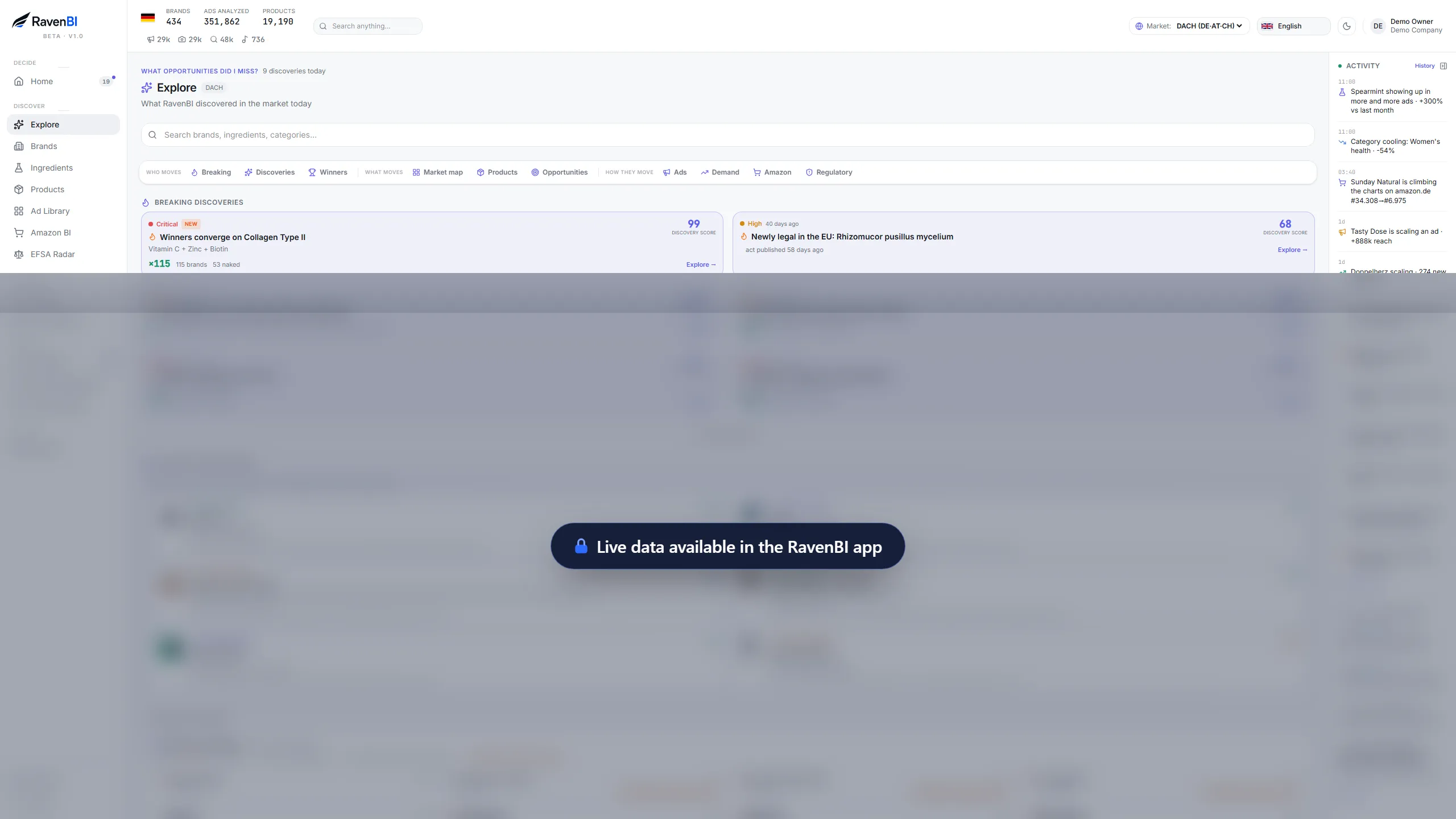
The day's discoveries in Explore — convergences, white spaces, regulatory changes — the starting point when you don't yet know where to look.
How to read the signals
- A problem with many searches and few dedicated ads = the classic whitespace candidate — goes straight onto the checklist for chapters 5 and 6.
- A problem with many old, active ads = proven demand, narrow window — enter only with clear differentiation.
- A problem with many new ads and few old ones = a market in testing; nobody has validated yet — you can wait to see what survives.
- An Explore discovery with a high score = a qualified hypothesis, not a decision: you owe it the same demand-and-claim verification as any idea of your own.
The typical mistakes
- starting with the ingredient and stopping there — the market's fastest-exploited layer;
- taking "few ads" as a gap without checking whether demand is zero too (chapter 5 exists exactly for that verification);
- ignoring the compound axes — the gap is rarely on a single one;
- treating the automatic discoveries as a shopping list — they're the start of the investigation, not its end.
Exercise
Take your category from chapter 2 and pull the two extremes from the Problem facet: the most crowded problem and the worst served one. For the second, open the existing ads and answer a single question: is there at least one brand that built its positioning around it? If not — you have your first concrete whitespace hypothesis. Write it on the sheet.
The problem hypothesis needs a vehicle: an ingredient or formula that solves it credibly. The next chapter returns to ingredients — but with the right instruments: demand face to face with ad pressure, not impressions.