
Choose the playing field: market, category, movement
Two identical launches, in two different categories, can have completely different odds from day one — before any marketing decision. Terrain matters: an accelerating category forgives mistakes more easily; a cooling one bills you for every single one.
The good news is that terrain leaves measurable traces. Categories don't cool in silence: first new ads decline, then launches thin out, then the leaders start moving their attention elsewhere. All of it is visible — if you look before the decision, not after.
What you'll be able to do after this chapter
- read your market's direction from a single page;
- tell a big category from a growing one — they're not the same thing;
- place any growth percentage on its base, so you don't confuse an early signal with a market.
The principle
A category healthy for entry shows several signals at the same time: active ads growing, new brands entering, new products appearing, existing ads running for months. A single, isolated signal is noise. And "big" doesn't mean "growing": the biggest categories are often high plateaus — plenty of demand, plenty of competition, zero growth. There you don't win with the ingredient; you win, if at all, with the offer and the execution.
The workflow in RavenBI
- Open Trends and pick your market from the switcher at the top.
- Read Market Movement: the direction of the whole market (active ads versus last month), new competitors, new products. This is the weather outside — the context for every decision below.
- Look at Heating up / Cooling down: the categories accelerating or cooling right now, each with its percentage, brand count and reach behind it.
- Go down to Category momentum: each category's trend over the last 10 weeks, with its stage — here you see whether the movement is a week old or a quarter old.
- Check Where the money is: the categories ordered by reach, with each one's leader — so you know how big the table is you want to sit at, and who runs it.
- Click into the category you care about — the next chapters start from there.
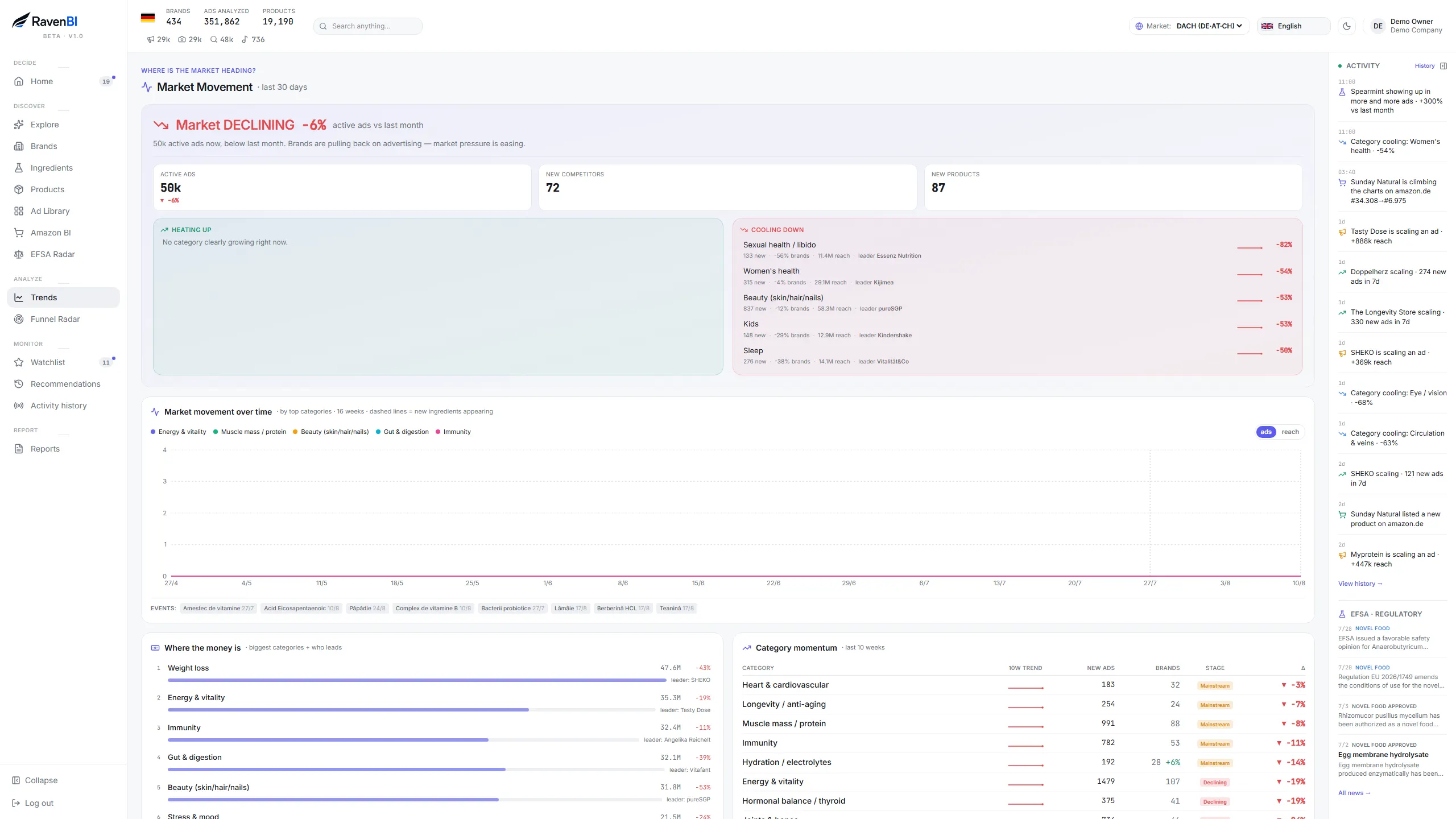
Market Movement, the categories heating or cooling and the 10-week momentum — the terrain, on a single page.
How to read the signals
- A category heating up on a small base (a few brands): early signal — put it under observation, don't bet on it yet.
- A category heating up on a large base: a real window, but with a clock — others see it too.
- A big, flat category: entering is justified only with a clear differentiation (chapters 3 and 6), not on "there's still room".
- A cooling category: not necessarily forbidden — but the burden of proof flips: you need a strong reason to enter against the current, not one to stay out.
- The whole market consolidating (active ads declining): windows don't disappear, but they narrow — positive signals need double confirmation (chapter 5).
The typical mistakes
- choosing the category by size, not by direction;
- reading a percentage without its base — the rule from chapter 1 first applies right here;
- looking at the category once — direction is a series, not a photo; that's why the 10-week momentum exists, not just this week's number;
- ignoring the weather outside: a "growing" category inside a generally consolidating market is a statement worth checking twice.
Exercise
Open Trends on your market and note: the direction of the whole market; your category — which list it appears in (heating, cooling, neither) and on what base; two neighbouring categories, as a benchmark. Then return to the sheet from chapter 1 and fill in the "window" line with what you saw — with the date next to it, because a month from now these numbers will be different.
Terrain is only the first layer: an entire category can look flat while, inside it, one specific problem is exploding with nobody serving it. That's exactly where the next chapter descends — the whitespace invisible at category level: problems, audiences and formats.