
The emerging ingredient: demand versus ad pressure
Sometimes an ingredient starts appearing in more and more searches months before it appears in ads. That interval — between consumer curiosity and the market's reaction — is the cleanest form of whitespace: demand already exists, and you're not yet competing with anyone for attention.
The problem: the interval isn't visible from the sidelines. To catch it manually you'd have to track, weekly, the search curves and the ad flow for hundreds of ingredients — in every market you operate in.
What you'll be able to do after this chapter
- read an ingredient's page in the right order: verdict → key comparison → commercial context;
- recognise the four combinations of demand × ad pressure and what each demands of you;
- use the page's positioning suggestion as a working hypothesis, not a recipe.
The principle
For any ingredient, the useful question has two halves: how fast consumer interest is growing and how fast the advertising supply is responding. A single number says nothing — the ratio between them says almost everything:
- demand ↑ / ads ↓ or flat = open space — the case you're after;
- demand ↑ / ads ↑ = the race has started — you can enter, but early and differentiated;
- demand ↓ / ads ↑ = attention bought on a falling curve — others pay ever more for ever less; stay out;
- demand ↓ / ads ↓ = a market closing down — there's nothing to save here.
The workflow in RavenBI
- Open the ingredient's page (from Ingredients, from search, or straight from an Explore discovery).
- Read the header: Opportunity Score, market stage, competition level and the launch window — the page's compressed verdict.
- Go down to the key comparison: Consumer demand (the 16-week search trend, for your market) face to face with Ad pressure (how many ads run on it). Here you place the ingredient in one of the four cases above.
- Check the commercial weight: how many brands, products, ads — the absolute base behind any percentage on the page.
- Read If you launched tomorrow — the positioning hypothesis proposed by the radar: category, audience, format, hook, offer and potentially relevant authorised claims. A starting point to validate (the claim, mandatorily, via chapter 6), not a recipe.
- Look at Goes well with — the combinations where the ingredient appears more often than chance: the raw material for the formulas chapter.
- If the ingredient passes the first reading, put it on the Watchlist — from now on you want to see how it moves, not just how it looks today.
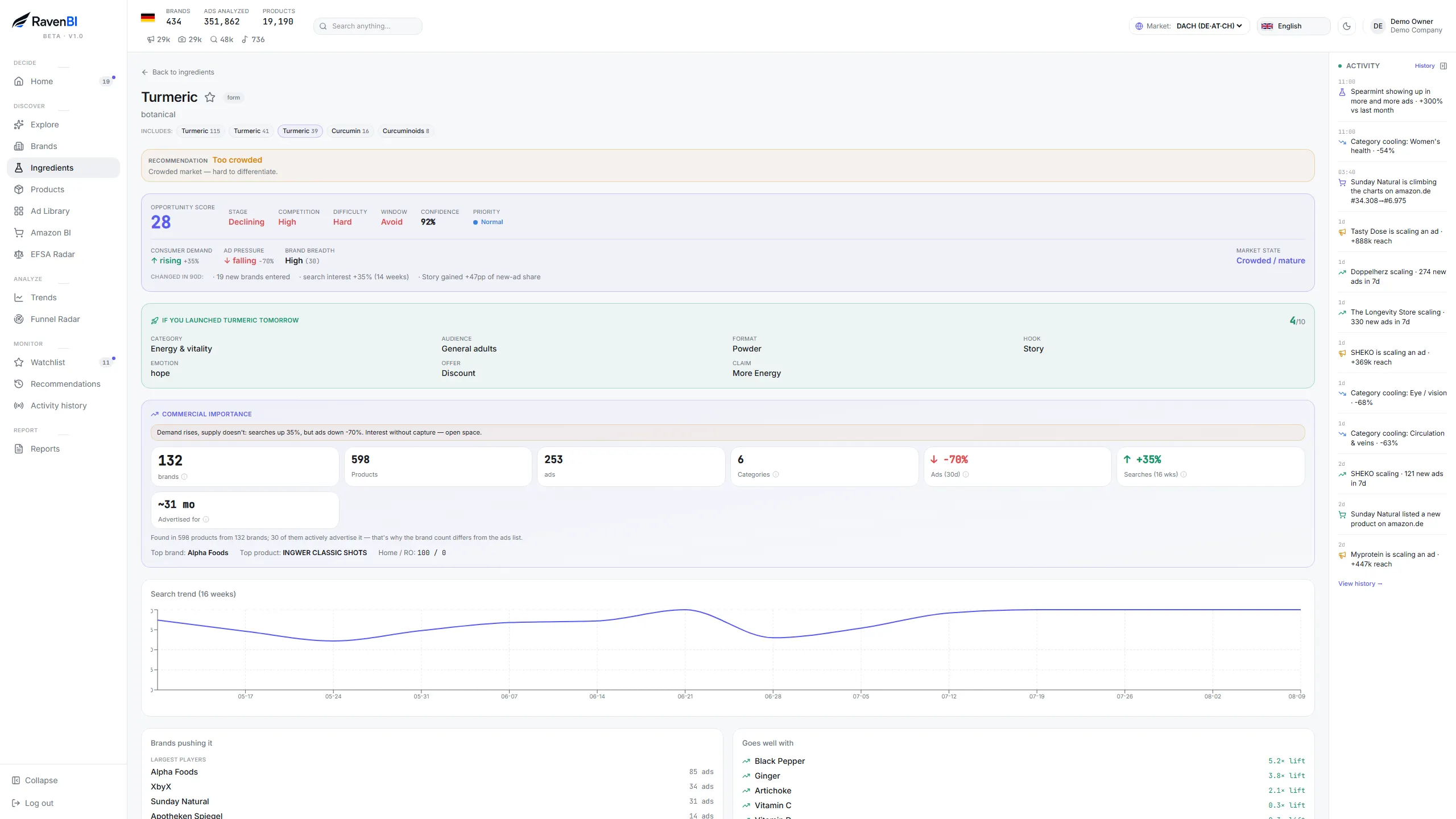
The verdict, demand face to face with ad pressure and the commercial context — an ingredient's full profile, on one page.
How to read the signals
- A high score on a small commercial base — a genuine early signal, but fragile: a few brands can flip the numbers; requires the confirmation in chapter 5.
- A "now" window in a crowded market — an apparent contradiction that resolves on the page: the window may come from the claim or the form, not the raw ingredient.
- Demand growing in only one market — check the page in every market you sell in; search curves are per market, and one country's whitespace can be a full table in the next.
- A regulatory status flagged on the page (novel food etc.) — not a footnote: the difference between opportunity and dead end; chapter 6 covers it in depth.
The typical mistakes
- reading the score without the base — an ingredient with 3 brands makes spectacular percentages out of nothing;
- treating "If you launched tomorrow" as a launch plan — it's the radar's hypothesis, not your due diligence;
- validating in the wrong market — demand in DE guarantees nothing in FR;
- stopping at the first good ingredient — pages are read in series, and the Watchlist exists to compare evolutions, not snapshots.
Exercise
Take three ingredients: one from the Explore discoveries, one from the problem identified in chapter 3, one from your own intuition. Open their pages for your market and place them in the four cases. Keep on the sheet only what falls into "open space" or "the race has started" — and only those names go on, to the test in the next chapter.
A rising search curve is a promise, not proof. Before building anything on it, you want to know whether other, independent sources see the same thing — or whether you're looking at an artefact of a single data series. Next chapter: confirmation across three sources.