
Amazon as a demand and price lens
Everything you've checked so far — searches, ads, formulas — measures intentions and promises. Amazon is where the money leaves traces: ranks improving, reviews accumulating, stock running out. For a founder, it's the closest public proxy for paid demand — imperfect, but cheap.
It's also a classic trap: Amazon is a market of its own, with its own seasonality, promotions and logic. What sells there doesn't automatically translate into a DTC brand — and conversely, absence from Amazon doesn't mean absence of demand.
What you'll be able to do after this chapter
- read the Amazon Market page as a control lens, not an absolute truth;
- recognise the two Amazon-specific signals: the empty shelf and the silent brand;
- know exactly what you can NOT deduce there — the short list that prevents expensive conclusions.
The principle
Three things useful to your decision can be deduced from Amazon: the direction of demand (categories whose median ranks are improving or degrading), the validation of the theme (products on your theme with visible traction — good rank and accumulating reviews) and the price context (at what prices the consumer accepts the theme, before any advertising).
What can't be deduced: anyone's margins, DTC demand (the audience buying from ads is a different audience from the one searching Amazon), and the future — a good rank today is a photo, not a guarantee.
Two signals deserve special attention, because they have no equivalent in other sources:
- The empty shelf — competitors on your theme out of stock while demand keeps flowing: the most perishable form of opportunity, with an expiry date;
- The silent brand — selling strongly on Amazon, zero Meta ads: demand without ad pressure — exactly the whitespace shape from chapter 4, seen through another lens.
The workflow in RavenBI
- Open Amazon Market (in Explore) for your market — the header gives you the size of the lens: how many products and brands the radar tracks there.
- Read Categories on the move: the categories whose median ranks moved this week — with the base (how many tracked products) next to each percentage, as always.
- Look at Competitors out of stock: the empty shelves on your theme, if any — and how large the estimated sales left on the table are.
- Go through Discovered on Amazon: the brands selling well without appearing in Meta ads — under-the-radar competitors that chapter 8 wouldn't catch from ads.
- For your theme, open the relevant listings: each one's rank and price history shows whether the traction is old or fresh, stable or a promo spike.
- Note the price range your theme lives in on Amazon — the starting point for the conversation about your own offer, even if you'll sell in another channel.
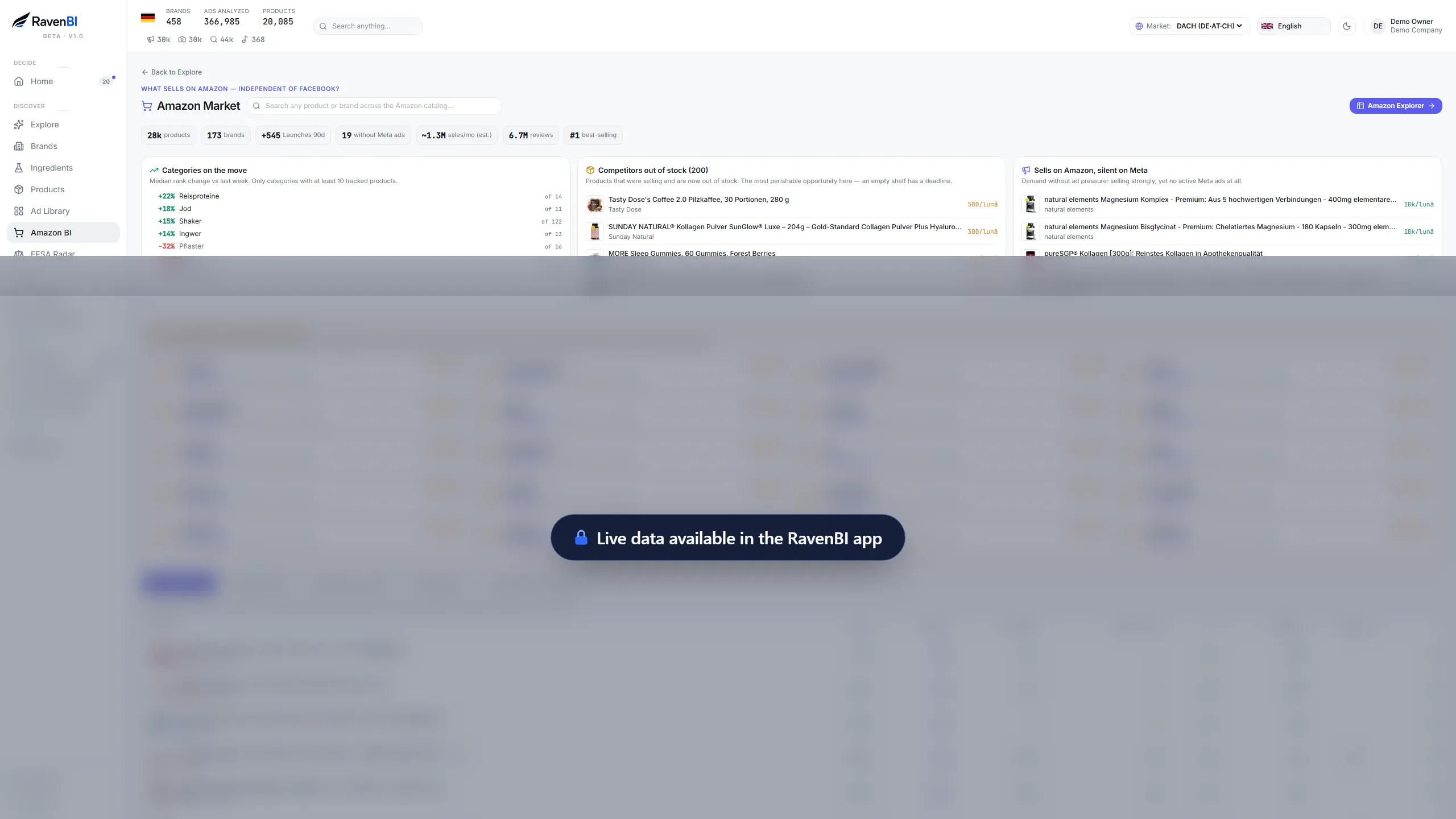
The categories on the move, the empty shelves and the brands selling without ads — the Amazon lens, on a single page.
How to read the signals
- The theme rising on Amazon and in searches = the confirmation from chapter 5 strengthens — independent sources are aligning.
- The theme rising on Amazon while ads stay silent = a variant of open space; check that the silence has no cause (impossible claim? unit economics?) before celebrating.
- An empty shelf on your theme = a window with a clock — but a retail window, not necessarily a brand window: useful mostly if you can be fast.
- A theme strong on Amazon, dead in searches and ads = marketplace demand, not brand demand — it sells there because it's there; don't build a DTC on it without further proof.
The typical mistakes
- reading rank as absolute sales — ranks are relative to the category and jumpy on promotions;
- validating a DTC brand exclusively on Amazon demand;
- missing the silent brands — your real competition includes players who appear in no ad library;
- noting the Amazon price and ignoring it when building the offer — the consumer has seen it, even if you haven't.
Exercise
For your theme, answer three questions from Amazon Market: is its category improving or degrading in ranks? are there silent brands already selling it well? what price range does it live in? Add the answers to the sheet — the "demand" line of the chapter 1 formula now has its third source.
Demand confirmed, formula with a voice, price context set. The last layer before the decision is the human one: who, concretely, are the competitors you'll be fighting — who dominates, who accelerates, who's just entering, and what their selling machines look like. The next chapter takes them one by one.