
The formula and the claim-space
This is where hard-won whitespace is most often lost: the founder has the right ingredient, the right moment — and builds a formula they're not allowed to say anything about. In the EU, health statements are regulated at Union level, based on EFSA's assessments — and a product without any relevant permitted statement competes with one hand tied behind its back: vague marketing, while legal risk grows.
The flip side is the beautiful part: the authorised claim can be designed into the formula from the start. A cleverly chosen carrier ingredient brings a permitted statement with it — under its conditions of use (dose, form, wording) — and suddenly you can communicate a benefit that part of the theme's visible competition doesn't.
What you'll be able to do after this chapter
- check, before any recipe, what authorised statements exist around your theme;
- read a winning formula as a structure: hero + carriers + claim + degree of crowding;
- find the claim white space: combinations with a permitted statement that few use.
The principle
A good launch formula stands on two legs at once: consumer logic (the combination makes sense for the problem from chapter 3 — and pairs appearing together more often than chance are a hint the market has already validated it) and compliant positioning room (at least one ingredient in the formula carries a relevant authorised statement, under its conditions of use). One leg without the other limps: a sensible but legally mute formula, or a valid claim glued to a combination nobody wants.
Worth saying plainly: authorised claims are not exclusive — anyone can use them within the conditions. The advantage isn't a monopoly; it's the lag: the period in which you communicate a permitted statement while your competitors haven't yet bothered to.
The workflow in RavenBI
- Open Winning Formulas (in Explore). Every formula identified in the market comes with its score, the number of brands running it, the authorised claim it can rest on and the launch window.
- Filter on white-space and low competition: combinations with a permitted statement and few active competitors — exactly the intersection this whole guide is hunting.
- For your theme, find the formulas containing the ingredient validated in chapters 4-5 and look at their structure: who's the hero, who are the carriers, what claim the ensemble carries.
- Switch to the EFSA Radar and read the decisions for every ingredient in your formula: approved or refused statements, novel food status, maximum levels — each with its summary. Here you also learn whether the star ingredient has a status problem that makes it unusable, however beautiful its demand curve.
- Back on the ingredient page, the Goes well with section shows its natural partners in the market — raw material for the carriers.
- The resulting formula — hero + carriers + targeted claim — goes on the sheet and off to the regulatory specialist. The data in RavenBI shows you where to look; the final validation of your label and ads remains a conversation with a specialist.
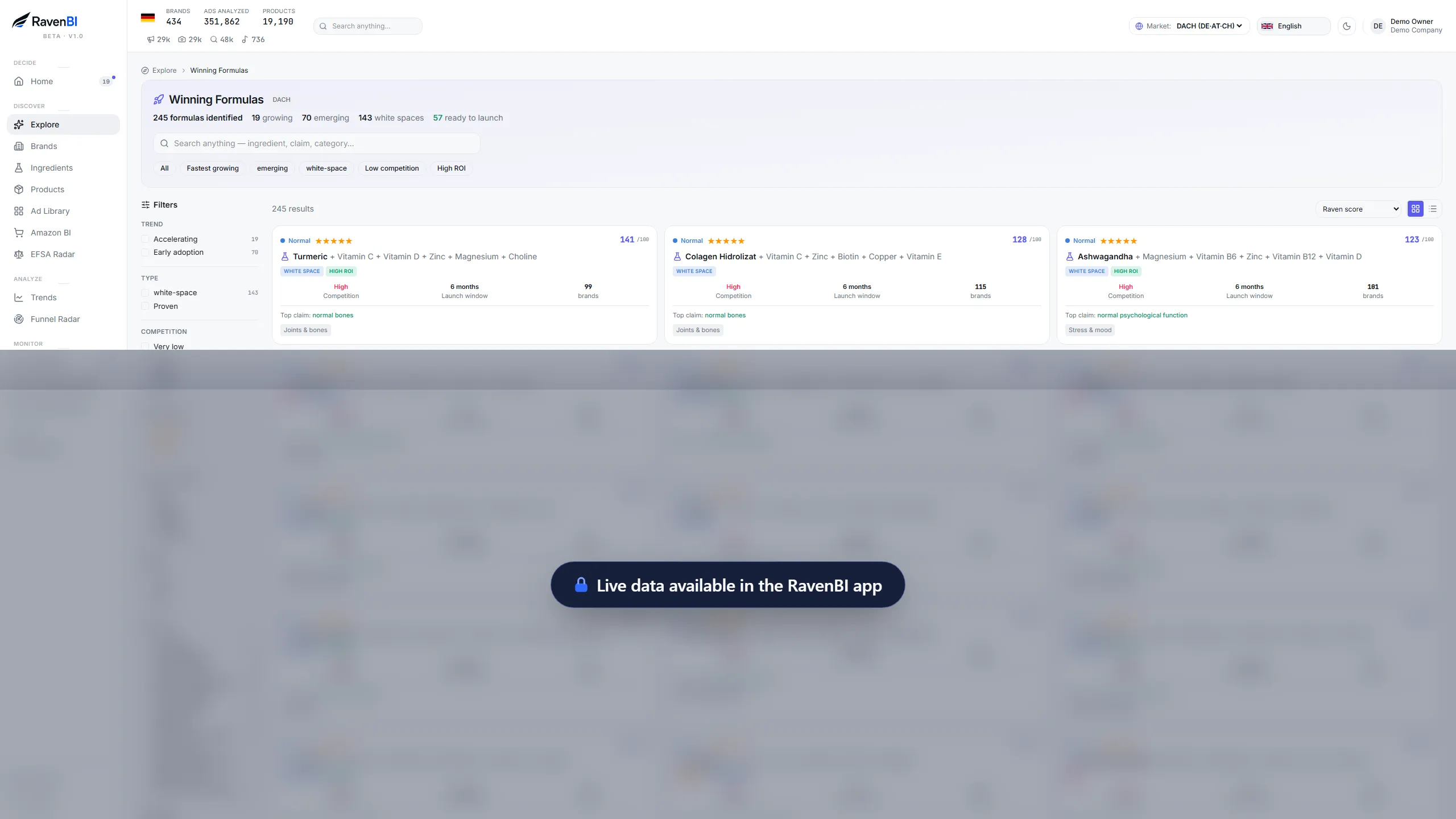
The formulas identified in the market, with each one's claim, competition and window — the gaps are flagged as white space.
How to read the signals
- A formula with many brands and a used claim = a validated, crowded recipe — good to study, bad to copy.
- A formula with a relevant claim and few active users = the claim white space — the main candidate.
- A theme where many brands run ads with no authorised statement detected = a double signal: the market communicates vaguely (you can stand out with a permitted statement) — but first check whether the vagueness isn't mandatory: maybe for that theme no usable claim exists at all.
- An ingredient with an unresolved novel food status = most likely a dead end on your launch horizon, however good the other signals — and the first thing to put on the specialist's desk.
The typical mistakes
- building the formula first and checking claims at the end — the right order is the reverse;
- reading "brands without an authorised claim" as an accusation or a guarantee — it's a research point, not a legal verdict;
- freely paraphrasing an authorised statement until it loses its compliance — the wording and conditions of use are part of the claim;
- skipping the specialist because "the radar said it's possible" — the radar shows the map; it doesn't sign the label.
Exercise
For your candidate, write the structure: hero (the validated ingredient), two-three possible carriers from Goes well with, and the targeted authorised claim — with its source in the EFSA Radar. Then write the differentiation in one sentence: what you'll be able to communicate, with cover, that few of the theme's competitors communicate today.
The formula has logic and has a voice. Before the verdict, two field checks remain: what Amazon says — the lens closest to the consumer's money — and who, concretely, the shelf neighbours are that you'll be fighting. Amazon first.