
What you can and cannot deduce from a public ad
Any ad library shows you thousands of creatives. None shows you which ones make money. The difference between a good analyst and one who fools himself lies in knowing exactly what can be deduced from public data and what cannot — and never crossing that line without declaring it.
This first chapter is the foundation of the whole playbook: the signal doctrine. Everything that follows rests on it.
What you'll be able to do after this chapter
- read an ad's four public signals and know how much each one weighs;
- explicitly name what you do NOT see — spend, ROAS, conversions — and refuse conclusions that assume them;
- use longevity as an honest proxy, with its limits declared.
The principle
Four things can be known about any public ad, and RavenBI puts each on the card:
- The age — how many days it's been running. The most honest public signal: brands tend to switch off quickly the ads that don't justify their investment, so what lives 60-180 days has passed a real operational filter.
- The status — active or stopped. A stopped ad is a finished lesson; a live one is a decision still being paid for.
- The estimated reach — how much audience it has touched. Not budget, but its visible trace.
- The variants — how many versions run in parallel. A message in seven variants is a message someone invests in methodically, not a throwaway test.
What can NOT be known, however good the tool: real spend, cost per acquisition, conversions, profit. Any analysis that sounds like it knows them — "this ad makes money" — has exceeded the data. The honest phrasing is: "the ad its owner has reasons to keep alive". It sounds like a nuance; it's the difference between reading the market and telling yourself what you want to hear.
The workflow in RavenBI
- Open the Ad Library on your market. Every ad card carries the four signals: age in days, status, estimated reach, number of variants.
- Switch to the Exposure sort — it combines longevity with reach, lifting exactly the ads with the strongest public signals to the top. (On EU markets, the default sort is 🔥 Scaling — recent acceleration; on UK and US, where Meta doesn't publish reach, the library opens straight on Exposure. Chapter 10 puts both to work.)
- Switch to the Recent sort and observe the contrast: the wave of fresh tests, most destined to disappear. The difference between the two lists is, visually, this chapter's entire doctrine.
- Pick three old ads and three new ones and compare their signals one by one — the calibration exercise that starts any market analysis.
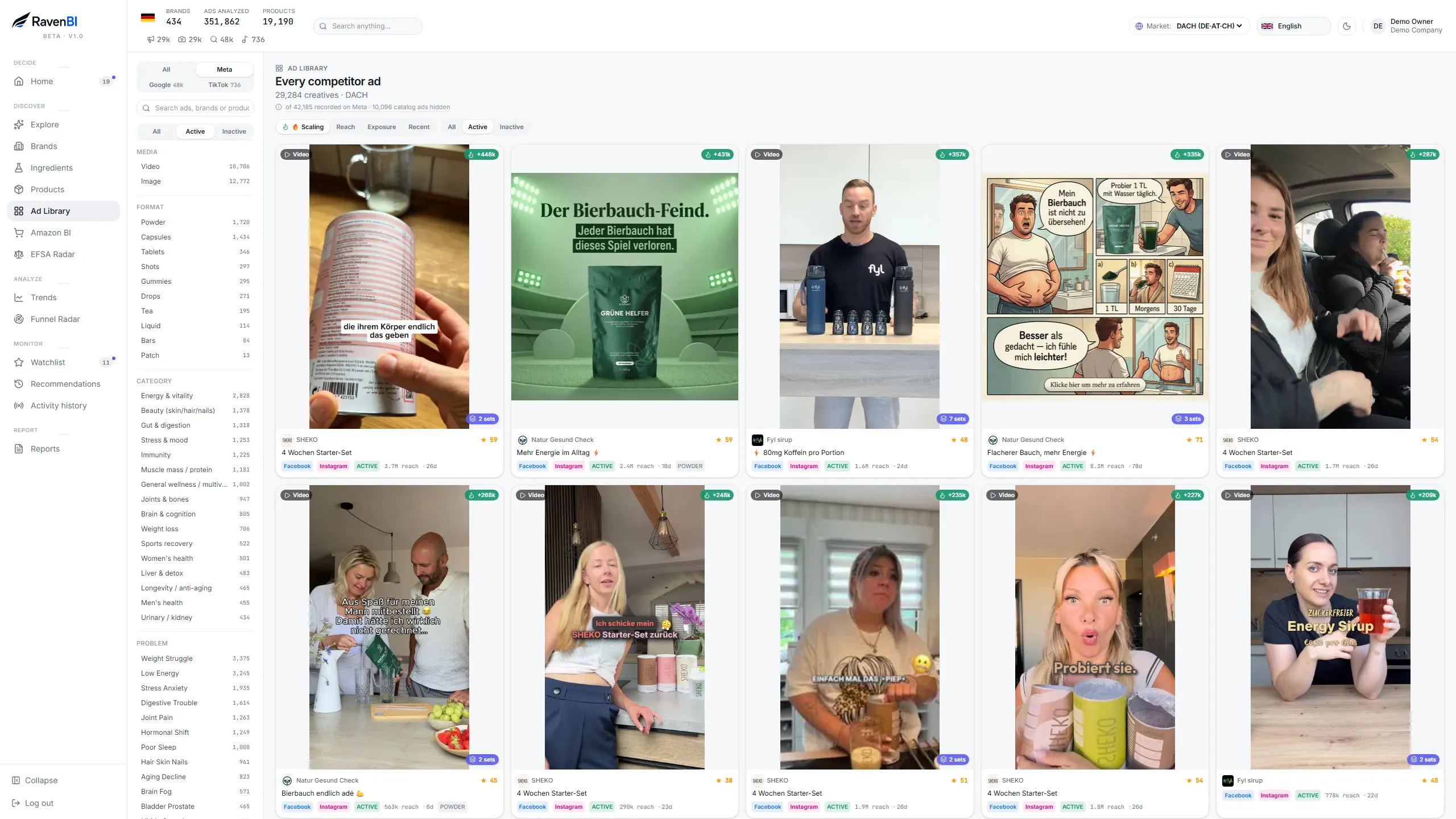
The four signals, on every card: age, status, estimated reach, variants — the raw material of the whole playbook.
How to read the signals
- Old + high reach + many variants = the triple signal — the ad with the strongest possible public signals; the first object of study.
- Old + low reach = alive, but on a low flame — perhaps a narrow profitable segment, perhaps inertia; interesting only if its theme repeats at others.
- New + exploding reach = visibility ramped up fast, not necessarily validation — check in two weeks whether it still exists.
- Many variants of the same message = the brand believes in the message and is hunting the execution — a signal about the message, not about any particular variant.
The typical mistakes
- reading reach as profit — it's the trace of the budget, not of the result;
- analysing a three-day ad like a ninety-day one — they haven't passed through the same filter;
- forgetting that longevity is a proxy, not proof — brand campaigns also exist, kept alive for other reasons;
- formulating conclusions the data doesn't support — any sentence with "makes money" requires data nobody on the outside has.
Exercise
Take an ad you were tempted to call a "winner" and write its four signals, one sentence each. Then rewrite your initial conclusion using only statements the signals support. If the final sentence sounds more modest than the first — the chapter has done its job.
Signals only make sense in context: the same age means something different in a crowded category than in an empty one. Before you analyse creatives, choose the terrain — the market, the category, the problem. That's where the next chapter begins.