
The psychology behind the funnel
So far you've analysed what's visible: signals, problems, hooks, formats. But the purchase decision happens on a layer the ad merely opens: the psychological tension — the fear the customer wants to escape, the hope they're buying, the proof they need to allow themselves to believe.
That layer can't be read from an eight-second creative. It's read from the whole funnel — ad, page, offer — because only there is the tension built end to end. And RavenBI summarises it for you, funnel by funnel.
What you'll be able to do after this chapter
- read a funnel's psychological profile: primary emotion, trust level, urgency, angles;
- compare the arena's long-running funnels and extract their shared tension — if it exists;
- use the psychological profile as an analysis level above the hook — more stable and harder to clone.
The principle
The Psychology section in the Funnel Radar compresses each funnel's AI analysis into a few lines: the primary emotion it builds on (hope, fear, control...), the secondary emotion, the urgency level, the trust level, plus the hooks and angles detected in the ads feeding it.
The power of the reading comes from comparison, not from the isolated case. A single funnel built on hope is a copywriter's choice. Three or four long-running funnels of the same arena, all built on the same tension — that's a discovery about the customer: the market has probably tried others too, and what survived convergently says what your audience really feels about its problem.
The reverse reading is just as valuable: if the arena's veterans split across different tensions, you have a market with distinct emotional segments — and choosing your tension becomes your first positioning decision, before any creative.
The workflow in RavenBI
- From your arena, take the three or four longest-running ads (chapter 1 taught you to find them) and open their funnels in the Funnel Radar.
- On each, read the Psychology section: primary emotion, secondary, urgency, trust, angles. Note them in a simple table — four funnels, five columns.
- Look for convergence: do they share the primary emotion? The same trust-urgency combination? Convergence is the signal; divergence is the map of segments.
- For the funnel closest to your positioning, descend from Psychology into the rest of the analysis — how does the page carry the tension the ad promised? (Chapters 7 and 9 take the thread further.)
- Write on the sheet the arena's dominant tension and — the chapter's decision — the tension YOU build on: the same one, executed better, or another, chosen explicitly.
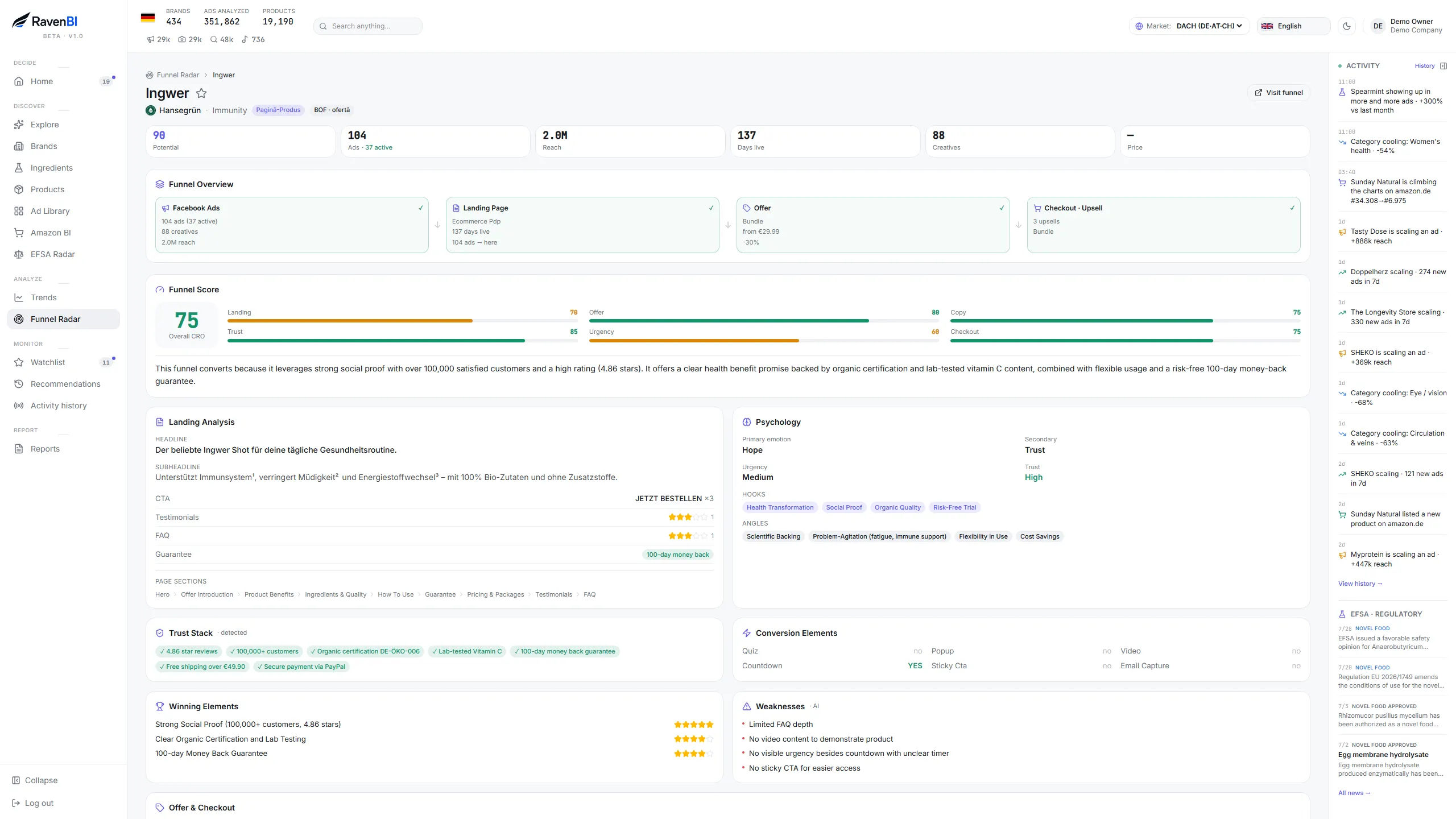
The Psychology section: primary and secondary emotion, urgency, trust, hooks and angles — the funnel's psychological profile, extracted automatically.
How to read the signals
- Emotional convergence at the veterans = the arena's proven tension — deviating from it is a bet, not a refinement; make it only consciously.
- Different tensions at different veterans = emotional segments — choose your segment before the creative, or you'll speak to everyone and no one.
- High urgency everywhere = an aggressive arena — the customer is trained on countdowns; calm can be differentiation or just invisibility — the test decides, not intuition.
- High trust, low urgency at the long-lived = a "pharmacy" arena, not a "bazaar" — proof beats pressure; chapter 7 becomes the most important one in the playbook for you.
The typical mistakes
- deducing the emotion from your own reaction to the ad — you are not the customer; classification plus longevity are better witnesses;
- analysing the ad's psychology without the funnel — the tension promised and not built on the page is exactly the break chapter 9 hunts;
- copying the tension without the segment — the same emotion is executed differently at 25 than at 55;
- treating the convergence as final — the arena's tensions move; chapter 12's note on the weekly rhythm applies here too.
Exercise
Fill in the table: four long-running funnels of your arena × primary emotion / secondary / urgency / trust / dominant angle. Under the table, a single line: the tension you build on and why — the same as the market's, or another, with the argument written down.
Every psychological tension rests, in the end, on the same pillar: the customer has to allow themselves to believe. And for that, ads and pages bring proof — reviews, certifications, guarantees, numbers. The next chapter weighs exactly that arsenal: proof, trust and credibility.