
The weekly checklist: the rhythm that keeps the playbook alive
Everything you've built across the 11 chapters has a shelf life. The arena moves: the veterans change their offers, the proven hooks wear out, a fast mover enters and rewrites the standard. An analysis done once is a photo of a film — useful today, misleading in a quarter.
The alternative isn't permanent re-analysis — nobody has that time, and it isn't needed. It's a rhythm: a short weekly routine in which the machine tracks the market for you, and you judge only what has changed.
What you'll be able to do after this chapter
- set up your tracking system: what goes on the Watchlist and which alerts you set;
- run the one-hour weekly routine — with the order of the steps and each one's questions;
- apply the reaction filter: which change demands a response and what's just the week's noise.
The principle
The system has two halves. The machine tracks: the Watchlist holds your entities (the key competitors, the category, the problem, the ingredients), Home shows you on every visit what changed since the last one, Alerts notify you between visits, and the weekly Live Snapshot brings the market's moves to your inbox. You judge: one hour a week, with a single big question — does anything I'm seeing change any decision of mine?
The reaction filter is the part that separates the professional from the anxious. Not every move demands a response: one new ad at a competitor is an ordinary Tuesday; a wave of new ads + a rewritten page + a changed offer, in the same week, at the same veteran — that's a repositioning in progress. The practical rule: you react to patterns confirmed across multiple signals, you ignore isolated events — the same doctrine from chapter 1, applied to time.
The workflow in RavenBI
- The setup (once): put the competitors studied in the playbook, the arena's category and problem, and the key ingredients on the Watchlist. Set Alerts for what you don't want to miss between routines. Activate the weekly Live Snapshot by email.
- The routine — step 1, Home (10 min): what changed since the last visit on your entities? Mark what deserves attention, ignore the rest.
- Step 2, the competitors' moves (20 min): for each marked signal, open the source — the new ad, the changed page, the moved offer. Apply the reaction filter: isolated event or pattern?
- Step 3, your bets (15 min): the list of young scalings from chapter 10 that reached their deadline — how many still live? — and your tests from chapter 11 at their judgment date: confront the hypothesis with the result, in writing.
- Step 4, the arena (10 min): the week's Live Snapshot — the market's big moves that touch your arena; once a month, also refresh the problem map from chapter 3.
- The output (5 min): a maximum of three written actions for the coming week. More than three means the reaction filter didn't filter.
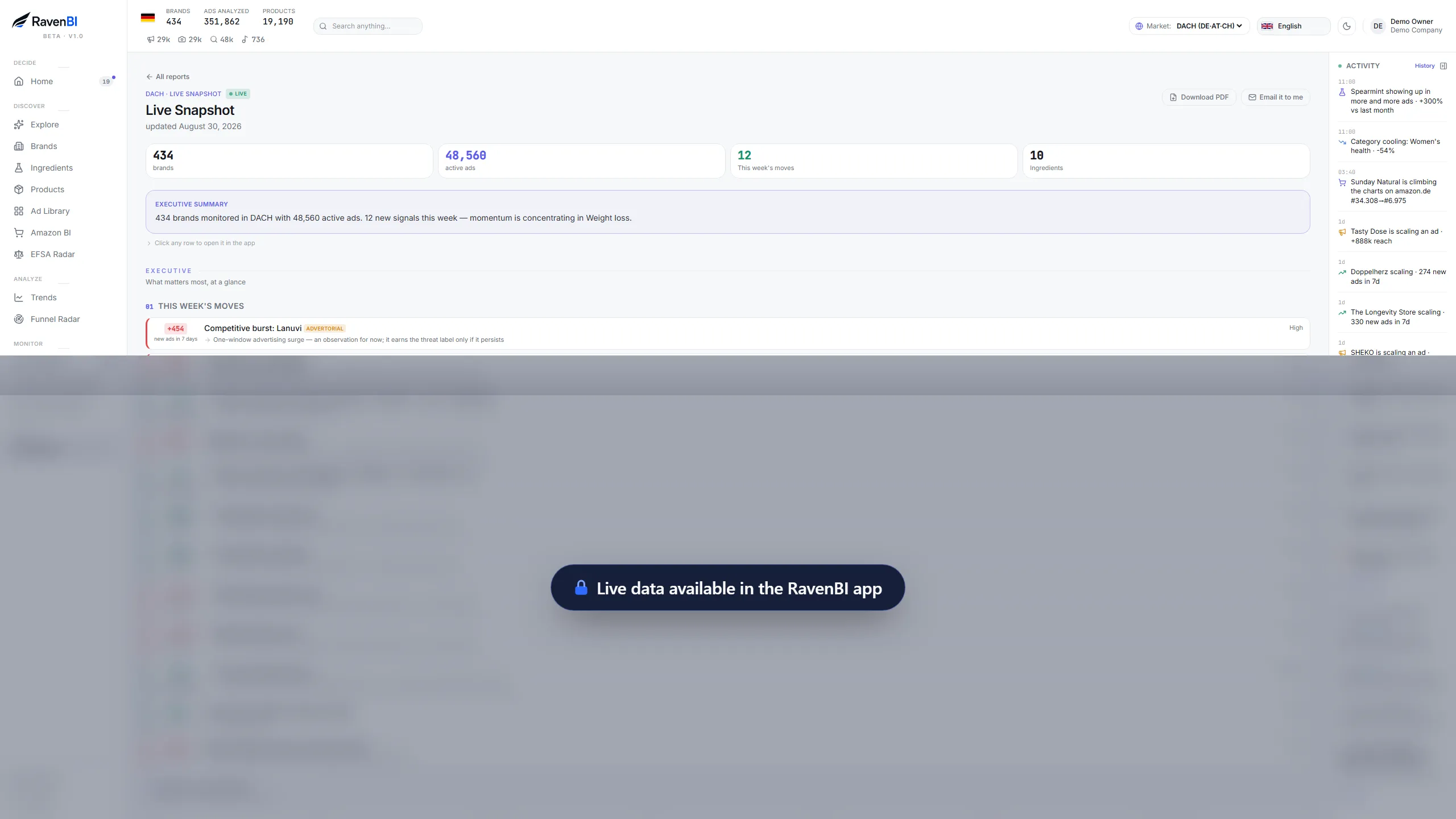
The week's moves, delivered — the half of the system the machine carries, so your hour is pure judgment.
How to read the signals
- One isolated signal at a competitor = a note, not a reaction — the market has ordinary Tuesdays.
- A confirmed pattern at a veteran (ads + page + offer moved together) = a repositioning — their playbook analysis gets redone, chapters 6-9 first.
- Your proven hook or angle appearing at new competitors = the wear begins — chapter 4 reopens before the decline in your account, not after.
- Weeks in a row with nothing to mark = either the arena is calm, or the Watchlist is too narrow — widen it once, then believe the calm.
The typical mistakes
- re-analysing everything weekly — the routine is judging the changes, not rebuilding the playbook;
- reacting to every event — your competitors have failed tests too; don't mistake them for their strategy;
- leaving the bets and hypotheses list unjudged — without step 3, your account doesn't learn, it only spends;
- stopping the routine when things go well — that's exactly when hook wear and fast-mover entries get missed.
Exercise
Do the setup now: the Watchlist populated, the alerts set, the snapshot by email, and the one-hour routine in your calendar, the same day every week. Run the first routine on what you already have: the bets list from chapter 10 and the hypotheses from chapter 11 get their first judgment dates.
With that, the playbook is closed — and only now does it start working. The 12 chapters gave you the method: signals instead of impressions, arenas instead of generalities, hypotheses instead of clones, rhythm instead of photos. We didn't give you the list of winning ads, because it only exists as an old photo of a film in motion. The method of reading it, though, is now yours — open RavenBI and run the first routine on your arena.
RavenBI PRO watches the supplement market for you — every ad, every funnel, every trend. From €149/month, cancel anytime.
See plans & pricing