
From hook to angle, without copying the market
No part of an ad is more fetishised than the hook — and rightly so: on video, attention is won or lost in the first seconds. But it's exactly the fetishising that produces the most common error: collections of hooks torn from context, cloned word for word, dying in the account because they were copied without their logic.
A hook doesn't live alone. It's the opening of an angle — the selling angle that connects the problem to the promise — and the angle is what proves itself or dies in the market. Whoever copies the hook without the angle copies the shell.
What you'll be able to do after this chapter
- tell the hook (the execution of the opening) from the angle (the selling logic) — and analyse at the right level;
- see, for your arena, which hooks repeat in long-running ads and which are just fashions;
- extract the pattern of a proven hook and build your own execution, not its clone.
The principle
RavenBI classifies every ad automatically, and in the Ad Library every hook has its facet: one click on the Hook facet and the library becomes that angle's page — all the ads in the market using it, with their signals in plain sight. This turns the vague question "which hooks work?" into a measurable one: which hooks appear in old, active, high-reach ads in my arena?
The reading rule, inherited from chapter 1: a hook that shows up in many new ads may just be a fashion — someone started, the rest cloned, the market hasn't voted yet. A hook that shows up in long-running ads across different brands is a proven pattern: several independent advertisers have been paying for months for the same opening. And of the two, only the second deserves deep study.
Correct extraction has three layers: what type of opening it is (question, counterintuitive claim, demonstration), what angle continues it (problem-agitation, scientific mechanism, comparison), and why it works for that audience. The clone copies layer one; the intelligent test rebuilds all three with your product and your voice.
The workflow in RavenBI
- On your arena in the Ad Library, open the Hook facet and pick an angle of attention — the list becomes that hook's page: all the ads using it. (Explore's discoveries often send you straight here.)
- On each chosen hook, apply the reading from chapter 1: how many ads are old and active, how many different brands stand behind them, what estimated reach each accumulates.
- Pick the hook with the strongest signals and open its three longest-running ads: note the type of opening, the angle that follows, and the audience it speaks to.
- Check the continuation: open the funnel behind the strongest ad — does the hook from the creative reappear in the page's headline? (Chapter 9 turns this into a discipline.)
- Write the extracted pattern in three lines — opening / angle / audience — without a single word copied from the ads you studied. What remains is the raw material of your test.
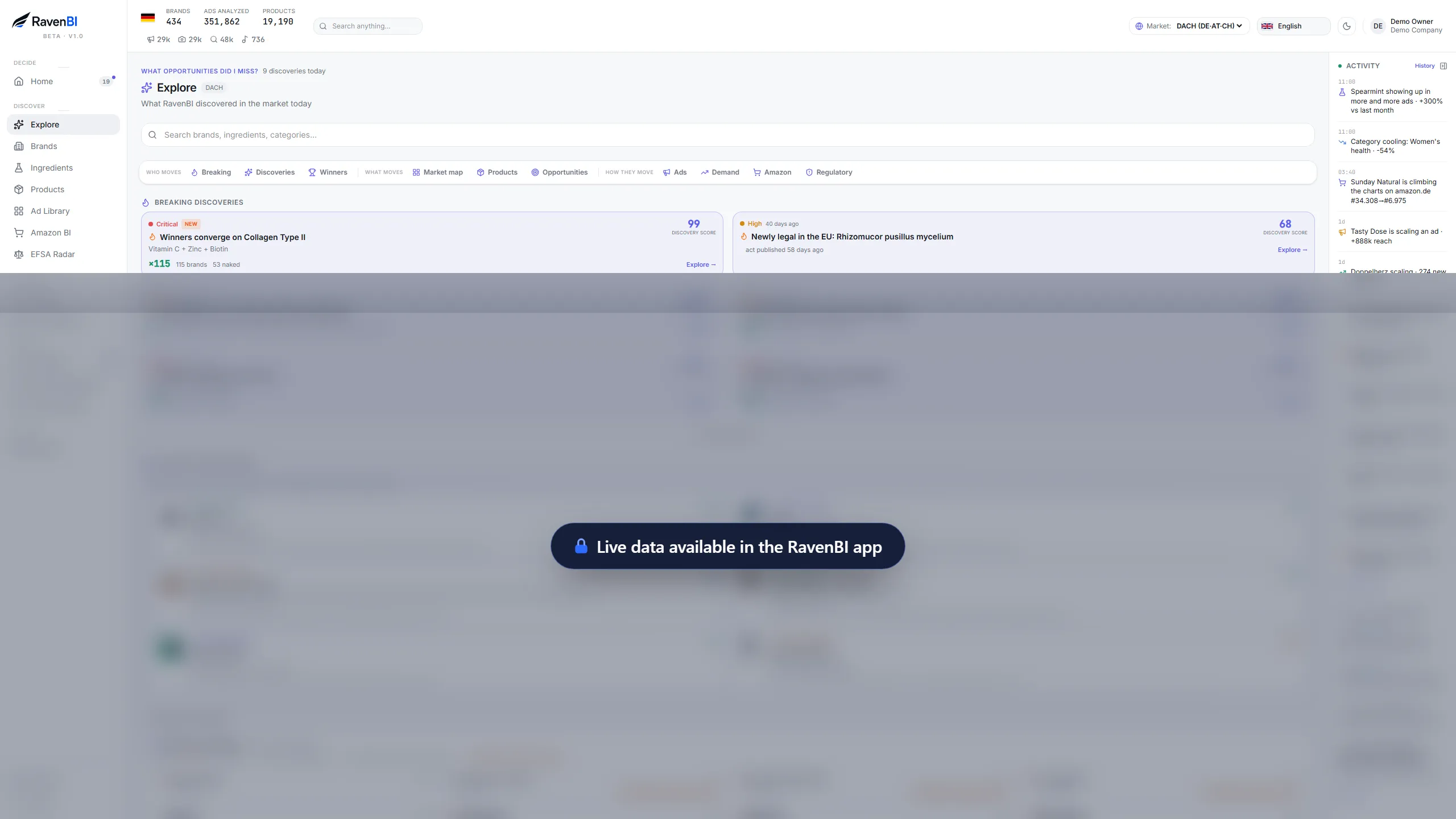
Explore: the day's discoveries, with the ads behind each one a click away — and in the Ad Library, the Hook facet gives you every angle of attention with all the ads using it.
How to read the signals
- A hook present at many brands, in old ads = the arena's proven pattern — study it first.
- A hook present at only one brand, however long-running = maybe their voice, not a pattern — it works for them; test it only seriously adapted.
- A hook exploding in new ads = a fashion in progress — note it and come back in a month; the market is voting now.
- The same angle under different hooks = the most valuable signal in the whole chapter: the selling logic confirmed independently of execution — that's where your creative freedom is greatest.
The typical mistakes
- copying the hook word for word — the clone competes with the original, which already has the optimisation history;
- analysing the hook without the angle — the shell without the fruit;
- taking fashion for validation — the number of appearances without age is just echo;
- ignoring the audience — an excellent hook for women 45+ can be noise for 25-year-old athletes.
Exercise
For your arena, pick the hook with the strongest signals and write its pattern in three lines: opening / angle / audience. Then write YOUR opening on the same pattern — with your product, your proof and your voice, zero borrowed words. You have your first test creative built on signals, not on taste.
The hook opens, but the form it's cast in — video with a person, static with the product, carousel — has its own market and its own patterns. The next chapter: formats and creative executions.