
Proof, trust and credibility
In supplements, the customer buys something they will swallow. The perceived risk is visceral, the trust barrier higher than in almost any other e-commerce category. That's why the long-running funnels of any arena end up resembling each other in one chapter: all carry an arsenal of proof — reviews, certifications, guarantees, numbers, references.
The useful question for you isn't "should I have proof?" — obviously yes. It's: what arsenal is already my arena's standard, and where can I build more than it?
What you'll be able to do after this chapter
- read a funnel's Trust Stack: what trust elements it carries and how it compares with the market;
- extract the arena's proof standard — the threshold below which your offer starts at a disadvantage;
- find the trust gap: the element few have and you can have.
The principle
The Trust Stack in the Funnel Radar automatically inventories the trust elements detected on each landing page — reviews and scores, customer counts, certifications, lab tests, guarantees, shipping terms — and next to it you see the market comparison: what percentage of the category's funnels uses each element.
The comparison turns the list into strategy. The elements almost everyone has are the entry ticket — lacking them puts you at a disadvantage before any merit of the product. The rare elements are the differentiation territory — and each funnel's Weaknesses section shows you, precisely, what even the veterans lack: their gaps are your list of chances.
A doctrine warning: nothing here says an element "increases conversion" — nobody sees other people's conversions. It says the long-running funnels carry it — and in the absence of internal data, that's the best starting point public data can give you.
The workflow in RavenBI
- For the long-running funnels analysed in chapter 6, read each one's Trust Stack section: what elements it carries, in what phrasings.
- Look at the market comparison next to it: which elements are quasi-universal in your category and which are rare.
- Open the Weaknesses section on each: what each veteran lacks — and how often the same gap repeats between them.
- Build two lists on your sheet: the standard (the quasi-universal elements — mandatory for you) and the gap (the lack that repeats at the veterans and that you can fill credibly).
- Check your own funnel — or its draft — against the two lists: cover the standard first, invest in differentiation only after.
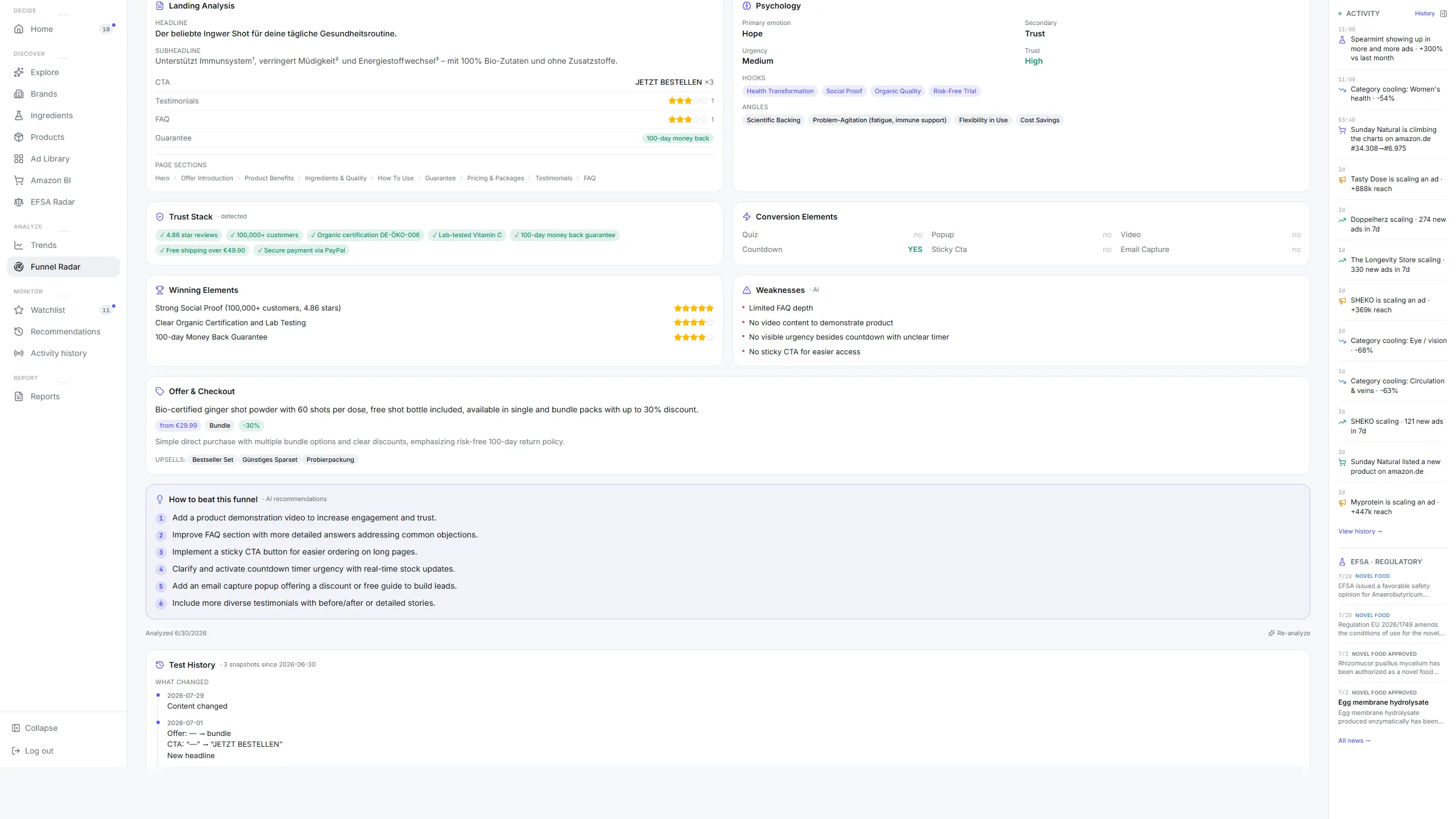
The detected Trust Stack, the weak points and the recommendations — the competitor's trust arsenal, element by element, with the market comparison alongside.
How to read the signals
- An element present at almost all the category's funnels = entry ticket — not differentiation; lacking it is an immediate handicap.
- An element rare, present at the longest-lived = a trust investment the veterans nevertheless sustain — the main candidate for your own.
- The same weakness repeated at several veterans = the arena's gap — the most accessible differentiation territory in the whole playbook.
- A long-running funnel with a thin Trust Stack = either a brand with trust capital from elsewhere (fame, community) or an anomaly — worth understanding before any conclusion.
The typical mistakes
- copying proof without substance — the invented certification or inflated reviews are the maximum legal risk on exactly the most attentively read page;
- investing in differentiation before the standard — the spectacular guarantee doesn't compensate for missing reviews;
- phrasing proof beyond what the law permits — numbers and medical references have their strict rules; everything the page promises must pass through the compliance filter of any launch — the EFSA claims guide covers it at length;
- reading other people's Trust Stack as a shopping list — every element demands real coverage on your side: real customers, real tests, guarantees you actually honour.
Exercise
Write your arena's two lists — the standard and the gap — from three or four long-running funnels. Then check your own funnel against the standard: every missing element is a maximum-priority task, before any new creative.
The proof carries the promise; the offer turns it into a transaction. And on the offer, the arena votes just as visibly: prices, packs, guarantees, thresholds. The next chapter: the offer, the price and the contrarian signals.