
European Supplement Trends 2027: 25 Ingredients, Categories and Product Formats to Watch
Most 2027 supplement trend reports start with consumer surveys or analyst forecasts. This one starts with observed behaviour: what 2,600+ supplement brands are advertising across nine markets, what consumers are searching for, and which tracked Amazon listings are moving on the European marketplaces covered by the radar.
Data source: RavenBI Market Intelligence. All figures below were measured on 24 September 2026 on the live radar; the live version of every number is in the application, recalculated daily. These signals change every week — treat this as a dated photograph of a moving object.
What are the biggest supplement trends for 2027?
The strongest 2027 signals split across five patterns: rising demand before ads catch up (L-glutamine, inulin, propolis), crowded validated ingredients (creatine, collagen, magnesium), Amazon-led product movement (electrolytes, whey, gentle mineral forms), advertising-led bets (saffron, shilajit, casein) and cooling standalone ingredients (biotin, B12, selenium). The detail — with the measured numbers behind each — is below.
How we measure supplement trends
For every ingredient we look at three signals that don't depend on each other:
- Search demand — Google-search interest per market, last 4 weeks vs the previous 4 (only counted where the baseline is reliable; single-market moves are labelled with their market);
- Ad pressure — how many brands are running Meta ads that mention the ingredient right now, and how many distinct creatives — meaning unique ad executions — are live;
- Amazon signal — across tracked listings on Amazon's five European marketplaces, whether the Amazon-displayed "bought in past month" number is rising for more products than it is falling (↑), the reverse (↓), or neither (→).
One deliberate omission: we do not publish "ad momentum +X% vs last quarter" percentages here. Public ad archives only show currently running ads, which makes historical windows systematically undercounted — a comparison that flatters every number. Where a percentage appears below, it comes from search demand or Amazon, sources that don't have that bias. Many trend reports blur that distinction; here it is the line between observed activity and narrative.
Supplement trend matrix: demand vs ad pressure
| Low ad pressure | High ad pressure | |
|---|---|---|
| Demand rising | 🟢 Opportunity | 🔥 Hot / crowded |
| Demand flat or falling | ⚪ Early or weak | 🟠 Advertising-led |
The interesting cells are the off-diagonal ones: demand without much advertising can point to margin, while advertising without visible demand can point to expensive demand creation. Here is where 25 real ingredients sit on that matrix right now.
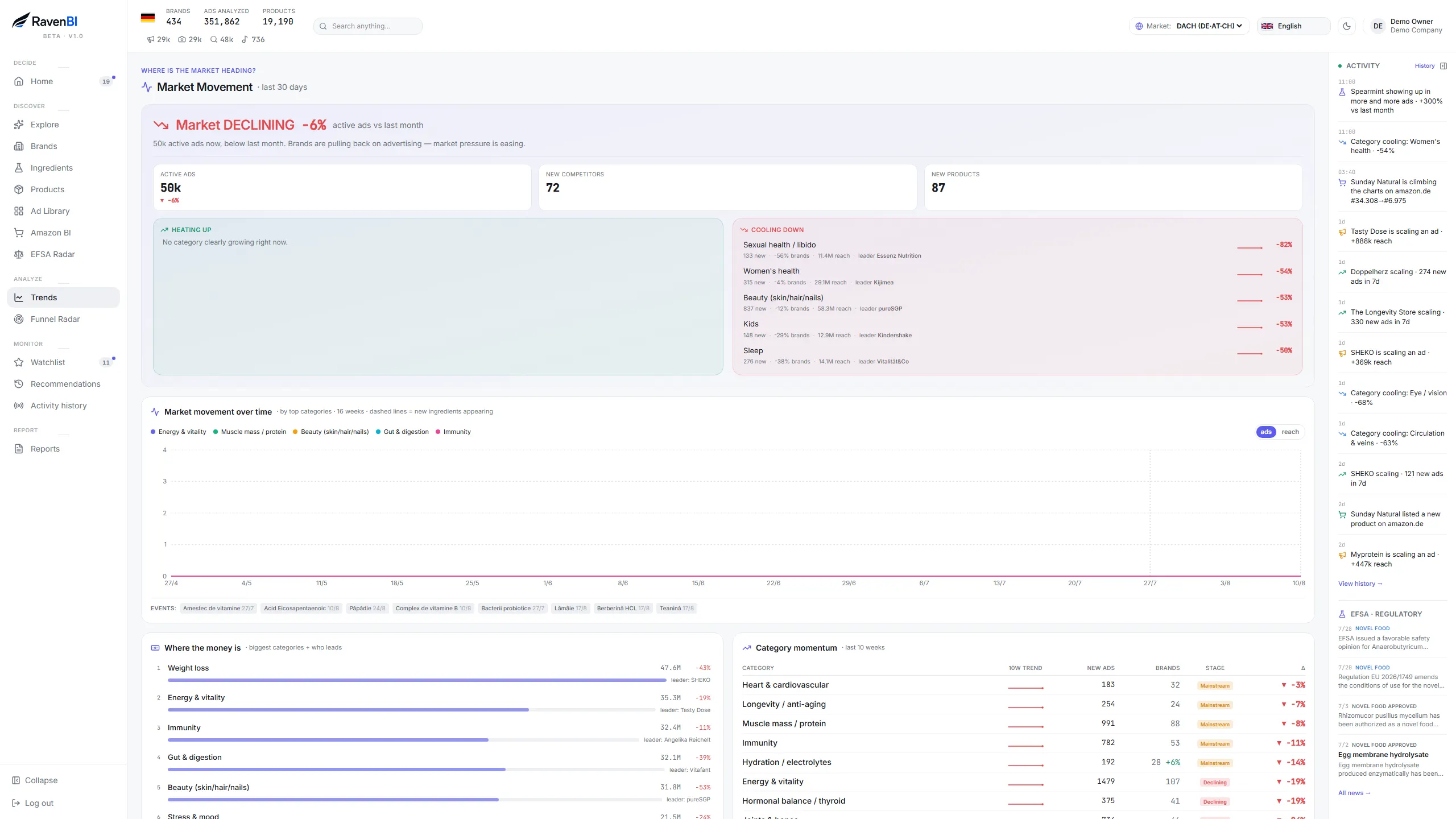
Where the matrix lives day to day: Market Movement, the categories heating up and cooling down, and Category momentum — recalculated daily per market.
🟢 Trending ingredients where demand is rising before ads catch up (7)
1. L-Glutamine. Search interest up in Spain (48→62 on the index) and Italy (15→24), Amazon signal ↑ (98 listings gaining in displayed monthly sold vs 66 falling), and only 32 brands advertising it across the nine markets. The gut-health repositioning of an old sports-nutrition ingredient is happening in commerce before it happens in ads.
2. L-Arginine. Italy's search index doubled in four weeks (33→69). Amazon signal ↑ (59% of moving listings gaining). 35 brands advertise it — mostly in circulation/pre-workout framings, barely any in the newer healthy-ageing angle.
3. Inulin. France's search index surged (54→100) while Germany cooled; the Amazon signal is the strongest in this list's fibre corner (54 gaining vs 29 falling). 27 advertising brands. The fibre-and-microbiome wave keeps arriving one market at a time — France looks like the next stop.
4. Propolis. Search up ~28% in Italy and Spain, 28 brands advertising. A traditional immunity ingredient with seasonal tailwind and southern-European demand that is not yet reflected in northern-European ad pressure.
5. Pumpkin seed protein. Search up ~41% in France and Spain (down in the UK), 42 brands advertising across 7 markets. Plant protein is fragmenting into specific seeds — and pumpkin is the one with demand data behind it.
6. Folate (Vitamin B9). Search up in Italy, Spain and the UK, down in Romania and Germany; 61 brands advertising. The methylated-vitamins conversation is pulling folate out of the generic B-complex.
7. Ginger. Search up ~19% in Romania, Spain and Italy; 69 brands advertising, but creative pressure is thin relative to demand breadth. Digestion and nausea positioning both have room.
Also in this cell, one line each: bromelain and the enzyme corner (64% of Amazon movers gaining, 29 advertisers) and spore-probiotic strains beyond the two big names.
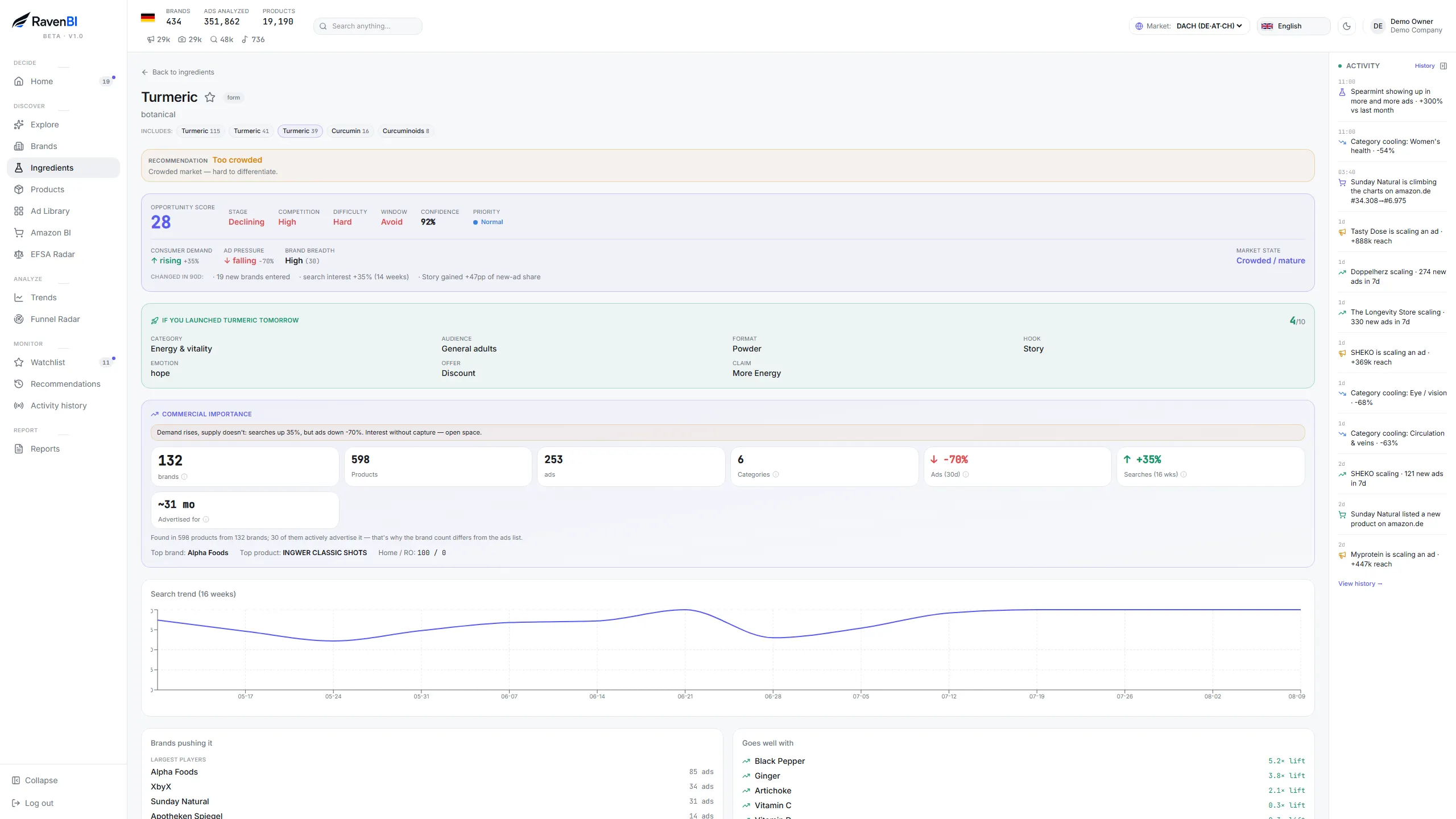
The pair behind every entry above: Consumer demand next to Ad pressure, with competition, window and confidence — one ingredient's full signal on a single page.
🔥 Crowded supplement trends: demand and ad pressure both high (6)
8. Creatine. Spain's search index went 45→100 in four weeks — the sharpest demand move on the whole radar — with the UK at the index ceiling in the current data. 188 brands advertise it. The longevity/women/cognitive repositioning has made this the most contested "new" old ingredient in Europe. Crowded ≠ closed: the form war (monohydrate vs gummies vs sachets) is still being fought.
9. Collagen. Search up in France (42→51), Italy (30→53) and Spain (65→75), flat UK/Romania, slightly down Germany. 249 brands advertising with ~3,000 active creatives — the most creative-saturated ingredient on the radar. Liquid formats and marine sourcing are the current differentiation axes.
10. Magnesium. The most widely advertised ingredient on the RavenBI European radar: 348 brands. Demand is regionally split — rising in Romania and France, and halving on the German search index (54→28) after two saturated years. The form (bisglycinate, threonate, malate) has replaced the ingredient as the real battleground.
11. Ashwagandha. The wave is migrating: search rising in Romania (60→100), Spain (50→78) and Germany, while falling in France (87→45) and the UK (61→42). 148 brands still advertise everywhere. Launching "ashwagandha, but for market X" is now a timing question, not a product question.
12. Omega-3. Search up in Italy (+37%) and Spain (+27%); 144 brands advertising. Algae-based and high-concentration formats keep the oldest category on this list moving.
13. Hyaluronic acid. Spain's search index jumped to its ceiling (71→100) while Germany and the UK cooled; 104 brands advertising. Beauty-from-within demand is shifting towards southern Europe.
Need the live version of this matrix? RavenBI plans start at €119/month and update ingredient, ad, Amazon and claims signals daily. See plans & pricing
🔵 Supplement product trends where Amazon is moving before the ads (6)
This is the cell you miss if you watch only ads or only Amazon — it requires both signals at the same time. Here, "moving listings" means tracked Amazon listings where the displayed "bought in past month" figure changed during the observed 90-day window.
14. Electrolytes. The clearest commerce story on the radar: potassium-led listings show 177 gaining vs 120 falling with ~152,000 units/month displayed sold across tracked listings, sodium-led ones 153 vs 114 (~181,000/month) — while only ~50 brands advertise the theme. Sticks, tablets and zero-sugar formats dominate the movement. (Our companion article on Amazon traction without ad pressure has the product-level list.)
15. Whey protein. 330 tracked listings gaining in displayed monthly sold vs 231 falling — one of the strongest positive skews at scale (~143,000 units/month displayed) — yet just 55 brands run Meta ads for it. Commerce looks stronger than the current Meta-ad footprint suggests.
16. BCAA. The strongest Amazon skew on the list: 73% of moving listings gaining (52↑/19↓), with 34 brands advertising. Often dismissed in commentary; the observed Amazon movement tells a more resilient story.
17. Iodine. Amazon ↑ (118/84) while search interest fell in Italy — a mature, repeat-purchase market where commerce no longer needs curiosity. 43 advertisers.
18. Cocoa flavanols. Amazon ↑ (69/49), 33 brands advertising. Sits at the intersection of two 2027 conversations: cardiovascular positioning and mood positioning.
19. Spore probiotics (Bacillus coagulans). Amazon ↑ (58% of movers gaining) with only 12 brands advertising the strain by name. Strain-level marketing is still rare in Europe — first movers get to define it.
🟠 Advertising-led: pressure without demand behind it (4)
Not accusations — structural observations. When creative volume runs far ahead of search interest, someone is paying to create a market. Sometimes it works; often it doesn't. Either way, following these ads into the auction means fighting the war chest that started it.
20. Berberine. 49 brands, ~500 active creatives. In France, weight-management positioning — the wave the market's own ads dubbed "nature's Ozempic" — is reheating, with the search index doubling (35→72). Elsewhere, demand no longer matches the creative volume.
21. Saffron. 40 brands, 420 active creatives pushing mood positioning across 9 markets. Search demand doesn't yet confirm a corresponding wave.
22. Shilajit. 356 creatives from just 32 brands — a TikTok-born trend being pushed aggressively into Meta. One genuine signal: Spanish search demand has just appeared from nothing. Watch whether the market answers the ads.
23. Casein. The most concentrated push on the radar: 464 active creatives from only 15 brands, with search interest down ~21%. A handful of sports-nutrition players betting heavily against the demand curve.
🔻 Cooling — plan around it (2 + the watch list)
24. Biotin. Search down in Germany (78→55), Romania (48→27) and Italy, while 121 brands still advertise it — the widest negative gap between pressure and demand on the radar. The hair-nutrition story is consolidating into multi-ingredient "beauty" formulas instead.
25. Vitamin B12. Search interest down in five of six measured markets (France 47→28 the steepest). 111 brands still advertise. Standalone B12 is becoming a feature, not a product — expect it bundled, not hero-ed.
Also cooling on the search side: selenium (sharp drops in the UK and Italy, flat elsewhere), glutathione, vitamin B5 and the perennial deflation of Garcinia. None of these has a published Amazon signal here that changes the cautionary read.
Supplement product format trends for 2027
The same radar shows forms moving, independent of ingredients:
- Chelated and "gentle" mineral forms — bisglycinate is becoming the default premium claim in magnesium and iron listings that gain sales;
- Hydration sticks and dissolvables — the electrolyte wave is a format wave as much as an ingredient wave;
- Year-supply and multi-month value packs — among Amazon listings gaining sales, large-count SKUs appear disproportionately often; the subscription-vs-stockpile battle is being decided in pack size.
What to do with this in your 2027 planning
- Match the cell, not the ingredient: a crowded ingredient with a fresh market (ashwagandha in Romania) or a fresh form (creatine sachets) behaves like an opportunity, not like its category average.
- Before committing stock to anything above, check the live version of its signal — these numbers were true on 24 September 2026 and started aging the same day.
- Respect the regulatory layer: several rising ingredients above carry limited or on-hold claim status in the EU; what you can say determines what you can sell. RavenBI flags this per ingredient — our EFSA claims guide explains how to read it.
These signals change every week. See live ingredient momentum across Europe in RavenBI — demand vs ad pressure, Amazon movement and claim status for every ingredient on this list, updated daily. Plans start at €119/month. See plans & pricing
RavenBI PRO watches the supplement market for you — every ad, every funnel, every trend. From €149/month, cancel anytime.
See plans & pricing