
The Carrier Ingredient: the Formula That Can Support the Claim
Here lies the central paradox of compliant supplement marketing: the ingredients that carry the story and the differentiation — ashwagandha, mushrooms, botanical extracts — almost never have an authorised claim. And the ingredients that DO have one — vitamins and minerals — struggle to differentiate on their own, because everyone has them.
Mature brands solved the paradox with a construction you'll see recurring in the market's formulas once you know to look for it: the hero brings the differentiation and the story, and the carriers — the vitamins and minerals added to the formula — bring the authorised claim that grounds the promise legally. "Extract of X with zinc, which contributes to the normal function of the immune system": the hero is X, the promise is carried by the zinc.
What you'll be able to do after this chapter
- read a market formula as a claim construction: who the hero is, who the carriers are, what promise the combination unlocks;
- use Winning Formulas to see the recipes that link your hero to authorised claims;
- build your own formula starting from the target benefit, not from what your supplier had in stock.
The principle
Winning Formulas (in Explore) inventories exactly these constructions: for each hero ingredient in the market, which carrier stack the "winning" brands use — in the radar's sense: those with long-lived ads and strong public signals — and what claim the combination unlocks. The reading has three parts:
- The recipe — the hero plus its typical carriers, with the claim the combination makes usable. Not a theoretical suggestion: it's what brands running long-lived ads on that hero already do.
- The gap — how many brands sell the hero "naked", with no carrier holding an authorised claim. That number is one of the most direct opportunity measures in all of RavenBI — with its correct reading: the brands in it communicate with no authorised claim detected (some legally, on the on-hold regime; others simply choose not to promise), and you can enter with the same story plus a promise grounded in the register.
- The variants — from the minimal formula to the "ideal" one (each added carrier unlocks a NEW claim, on a distinct theme) to the market norm. The difference between them is the difference between a single claim and a fan of communication themes.
Two doctrine warnings. First: the authorised claim is not exclusive — anyone adding the carrier within the conditions of use can use the same wording; your advantage isn't monopoly, it's that most of the gap doesn't bother. Second: the carrier must be present in the dose that meets the claim's conditions of use — a token trace of a vitamin unlocks nothing; the final check here belongs, again, to the specialist.
The workflow in RavenBI
- Open Explore → Winning Formulas and search for your hero (or the hero candidates, if the formula isn't closed yet). Each one's page shows the recipe: the winners' carrier stack and the unlocked claim.
- Read the gap number: how many brands sell the hero without a carrier holding an authorised claim. The bigger it is, the more of the market communicates with no authorised claim detected — and the more valuable your entry with the correct construction.
- Compare the formula variants: minimal, ideal, market norm. For each carrier in the ideal variant, see what NEW claim it unlocks — that is your fan of communication themes, which chapter 5 works with.
- Open the Ingredients pages of the chosen carriers and read their Regulatory & EFSA section: their exact claims, with everything about the conditions. What leaves here for the specialist is a short, concrete list, not a vague question.
- Close with the honesty test: does the resulting formula make NUTRITIONAL sense, not just legal sense? A carrier that has no business sitting next to your hero shows — and the customer who reads labels notices. The good construction is the one where the carrier completes the product's logic, not just the file.
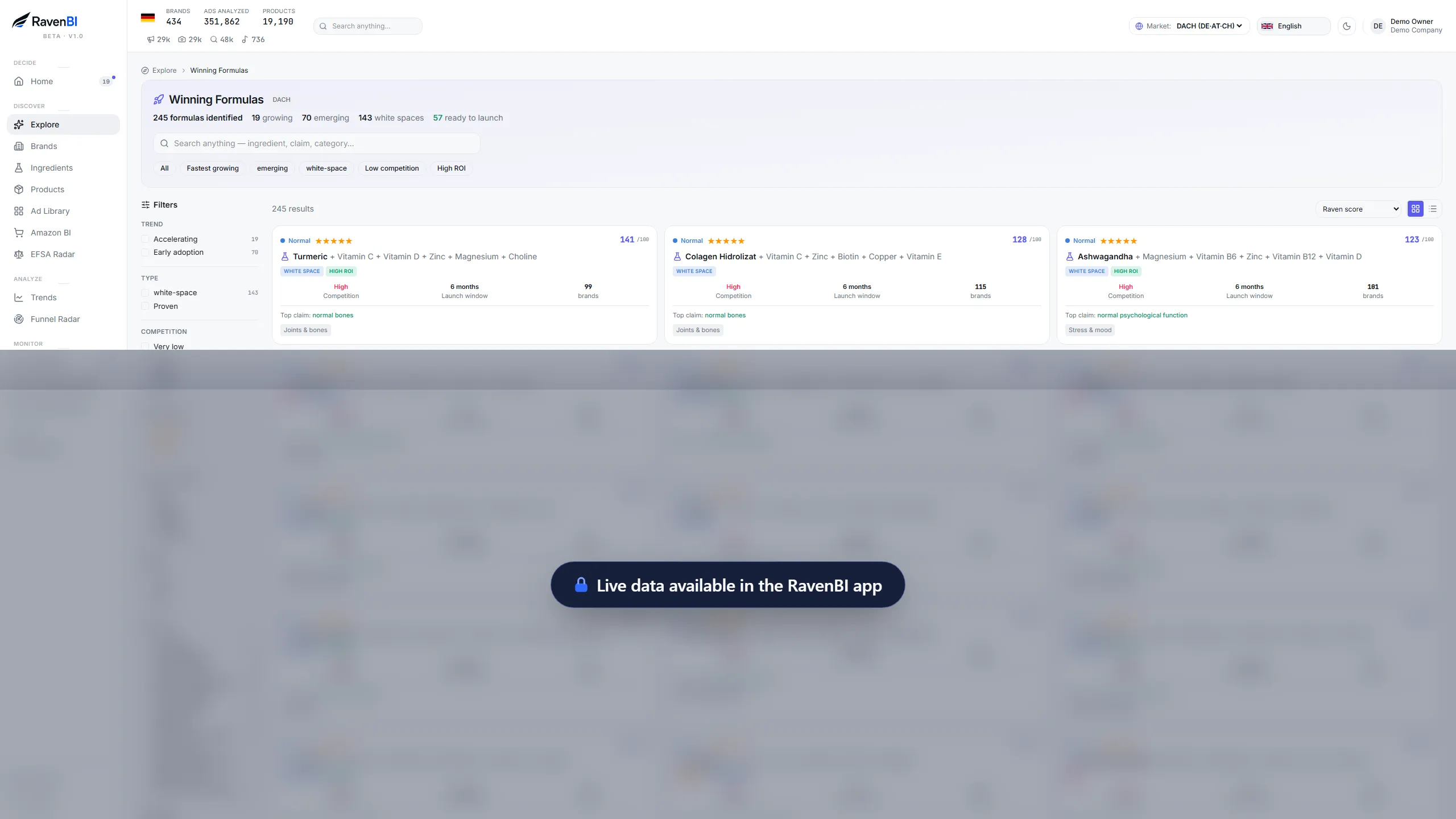
The market's recipes: the hero, the carrier stack, and the claim the combination unlocks — plus how many competitors sell the hero with no authorised claim detected.
How to read the signals
- Hero with a big gap (many competitors with no authorised claim detected) = the classic entry window — the same story as the market, but with a promise supported by the register; the chapter's most frequent opportunity pattern.
- Hero that the winners all link to the same carrier = the market's validated construction — deviating from it isn't forbidden, but it demands a reason;
- Hero with numerous "on hold" claims = the piece has a voice of its own under the transitional regime — you can communicate on it, but the carrier layer remains what gives the promise its most solid base;
- Carrier rare in your category but with a claim on the hero's theme = formula differentiation at a low price — check the dose its conditions of use require before you celebrate.
The typical mistakes
- building the formula and looking for the claim afterwards — the right order is target benefit → claim that covers it → carrier that unlocks it → formula;
- sprinkling the carrier in a token dose — with the conditions of use unmet, the claim doesn't exist, no matter what the label says;
- reading the authorised claim as a monopoly — it isn't; it's an open gate the rest of the market merely forgets to walk through;
- gluing on carriers with no product logic — the formula that looks like a legal file with powder around it shows, and convinces no one.
Exercise
For your hero, write the full recipe on one sheet: the hero, the winners' carriers from Winning Formulas, the claim each unlocks, and the gap number — how many sell the hero with no authorised claim detected. Then decide your variant: minimal, ideal, or market norm — with one line of argument. The list of chosen carriers, with their claims, is exactly the document you take to the specialist.
You have the formula and its claims. The next question is where you stand with them in the market: who else communicates on these themes, where promises are made without register support, and where the space is in which a solid claim actually differentiates. Next chapter: the map of claim differentiation.