
Claims Across the Funnel: Ad, Landing, Product, Trust Stack
The most common way an otherwise disciplined marketing operation leaves the perimeter is not a scandalous ad. It's drift: the ad promises correctly, the page "adds a little something", an old banner promises something else, and the displayed reviews say what nobody is allowed to say. Every piece passed a check at some point; nobody has looked at the whole in a long time.
For anyone analysing the market, that same drift is study material: long-lived funnels tend to keep the promise constant along the whole thread — their consistency deserves study as architecture, even though longevity doesn't legally validate anyone — and the ones where ad and page say different things show you exactly what the error looks like, so you can recognise it at home.
What you'll be able to do after this chapter
- audit the health promise's thread across a whole funnel: ad → landing → offer → trust elements;
- use Funnel Radar to put the same competitor's ads and page face to face;
- build your own audit: the inventory of the points in the funnel where a promise appears — including the forgotten ones.
The principle
A funnel makes promises in more places than it seems, and the audit starts with their inventory:
- The ad — hook, body, claim. On each ad's page in RavenBI, the Observed claim shows what promise the analysis detects in the text (an informational observation, not a legal assessment — but exactly what you need for fast inventorying).
- The landing page — titles, sections, listed benefits. The Landing Analysis in Funnel Radar lays them out structured, and next to it, Ads driving this funnel — the ads bringing traffic to the page. Together, the two sections make the thread visible: does the ad's promise continue on the page, or does it drift?
- The trust stack — displayed reviews, certifications, guarantees. The most often forgotten zone: a review saying "it cured my X" published on YOUR page is a medical promise on your page, whoever wrote it.
- The offer and the cart — bundles, upsells, their short texts, where promises sneak in compressed and unvalidated.
The golden rule of the thread: every health promise stays within the perimeter of its basis — an authorised claim or, where applicable, an on-hold one — and does not escalate from floor to floor; what varies freely between floors is the rest (context, proof, offer). The ads guide called this principle ad → landing consistency; here we read it on the claim's specific layer, where inconsistency costs not just clicks but also risk.
The workflow in RavenBI
- Pick two or three long-lived funnels from your arena and open them in Funnel Radar. On each, put Ads driving this funnel and the Landing Analysis face to face.
- Follow the health promise along the thread: how it sounds in the ads (the Observed claim on each), how it sounds in the page's titles and sections, what appears in the trust stack. At many veterans you'll find the same promise, phrased consistently — the construction to study for structure, not a certificate of compliance.
- Repeat on a funnel with weak signals and hunt the drift: where does the promise diverge between floors? Every divergence found at others is a type of error you learn to look for at home.
- Make your own inventory: all the points in your funnel where a health promise appears — active ads, landing, PDP, displayed reviews, banners, cart emails. The list is longer than you think; the forgotten points are exactly the ones that drift.
- Pass each point through chapter 5's filter: is the promise the authorised one, within the perimeter? What fails gets rewritten or removed — and the inventory becomes the periodic audit document of chapter 7.
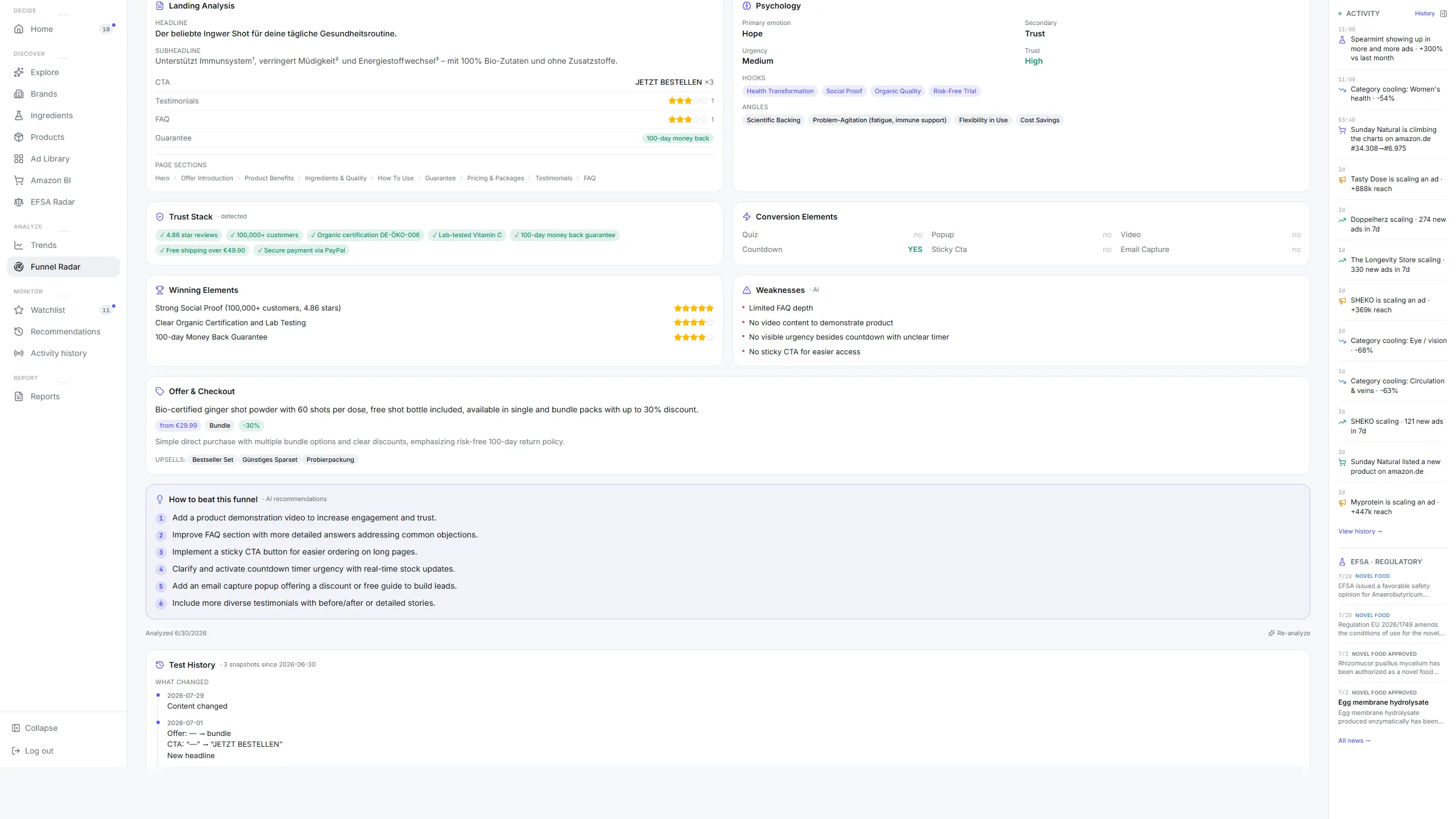
The ads feeding the funnel, the landing page's structure, and the trust elements — the promise's entire thread, on a single screen.
How to read the signals
- The same promise, consistent along the whole thread, on a long-lived funnel = the mature construction — to be studied element by element as an architecture model, not as proof of compliance;
- Ad within the perimeter, page that escalates = the classic drift — the promise grows as it approaches the cart; the most frequent pattern and the easiest to reproduce involuntarily at home;
- A trust stack promising what the copy avoids = the perimeter bypassed through the customers' voice — a signal that your own audit must also cover displayed content, not just what you wrote;
- A funnel changing the health promise between ad variants = either a positioning test (legitimate) or a lack of discipline — the page's history gives you clues for a hypothesis, not a verdict on intent.
The typical mistakes
- validating the pieces and never the whole — every text was correct at some point; together they promise something else;
- forgetting the "inherited" content — the banner from two seasons ago and the old campaign page stay public and keep promising in your name;
- treating displayed reviews as someone else's voice — on your page, they are your communication;
- auditing once — the funnel changes weekly; an audit without a rhythm is a photograph that ages as fast as any other.
Exercise
Make the complete inventory of the points carrying a health promise in your funnel — from the active ads to the displayed reviews and the cart texts. Note for each: the promise, whether it's the authorised one, whether it's within the perimeter. The failing points become your repair list; the whole inventory becomes the document the next chapter puts on repeat.
Everything you built in this guide — chosen claims, formula, copy, audited funnel — is correct TODAY. But the register moves, the market moves, and your funnel gets rewritten piece by piece. The last chapter: monitoring — how to stay compliant and informed without turning it into a separate job.