
Navigating the EFSA Radar
The official sources of European regulation are public and free — and almost nobody in marketing reads them. Not out of laziness: because of the format. Decisions are scattered across registers and legal acts, written in scientific-opinion language, with no visible link to the question you actually care about: does this decision concern me?
The EFSA Radar in RavenBI does exactly that translation: it gathers the decisions relevant to supplements — health claims, novel foods, maximum levels, legislation — ties them to the ingredients of your market, and tells you, per decision, who is exposed: how many brands are advertising the ingredient right now, how many products contain it, how many active ads are running on it.
What you'll be able to do after this chapter
- filter the radar to what concerns you: decision type, source, year, ingredient;
- read a decision through its three layers: what was decided, what it means for you, how exposed the market is;
- tell the decisions that demand a reaction from those that are merely regulatory background.
The principle
The radar lives in Explore → EFSA Radar and is built on a simple idea: a regulatory decision becomes interesting only when it intersects with the market. That's why every entry has three layers:
- The decision — the type (claim approved / refused / on hold, novel food, max level, legislation), the date, the source (the EFSA/EU catalogue or EUR-Lex), with a plain-language summary and the link to the official source.
- The translation — the "What this means for you" section: what the decision concretely changes for a brand using the ingredient.
- The exposure — how many brands in the tracked markets are advertising the ingredient NOW, how many products contain it, how many active ads are running. Here an abstract decision becomes an impact figure.
The decision types carry different weight for you. Claim approved is rare and precious — a new communication gate for the whole market; there may be an early-positioning window, to be weighed against the exposure and the active materials next to it. Claim refused means you don't build your communication on that ingredient-benefit relationship without a review with your specialist — and if the market communicates heavily on it, the decision's exposure is a list of materials to check, not a verdict on anyone. Novel food authorised opens an ingredient or a new use in the EU, under the specific conditions of the decision — scope of use, specifications, sometimes restrictions — a different kind of window, this time about product, not message. Max levels and legislation are background that becomes urgent only when it touches your dosages.
The workflow in RavenBI
- Open Explore → EFSA Radar on your market. First contact: walk the list without filters, just to calibrate your eye to the rhythm of decisions — how many appear, of what type, how often.
- Filter on Type → Claim approved and read the latest decisions: which communication gates opened recently and for which ingredients. On each, look at the exposure: a freshly approved claim on an ingredient with many active ads is a change that touches a lot of active market at once.
- Switch to Claim refused and do the reverse reading: which wordings have closed — and how exposed the market is on them. You're not hunting culprits here; you're hunting wordings NOT to build your own communication on.
- Search the ingredients of your formula (or the planned one) in the search bar and read their whole regulatory history: claims, novel food, levels. The link to the ingredient page leads onward, to the full commercial picture.
- Whatever concerns you directly goes on the Watchlist — chapter 7 builds the monitoring rhythm on it; for now it's enough not to lose the thread.
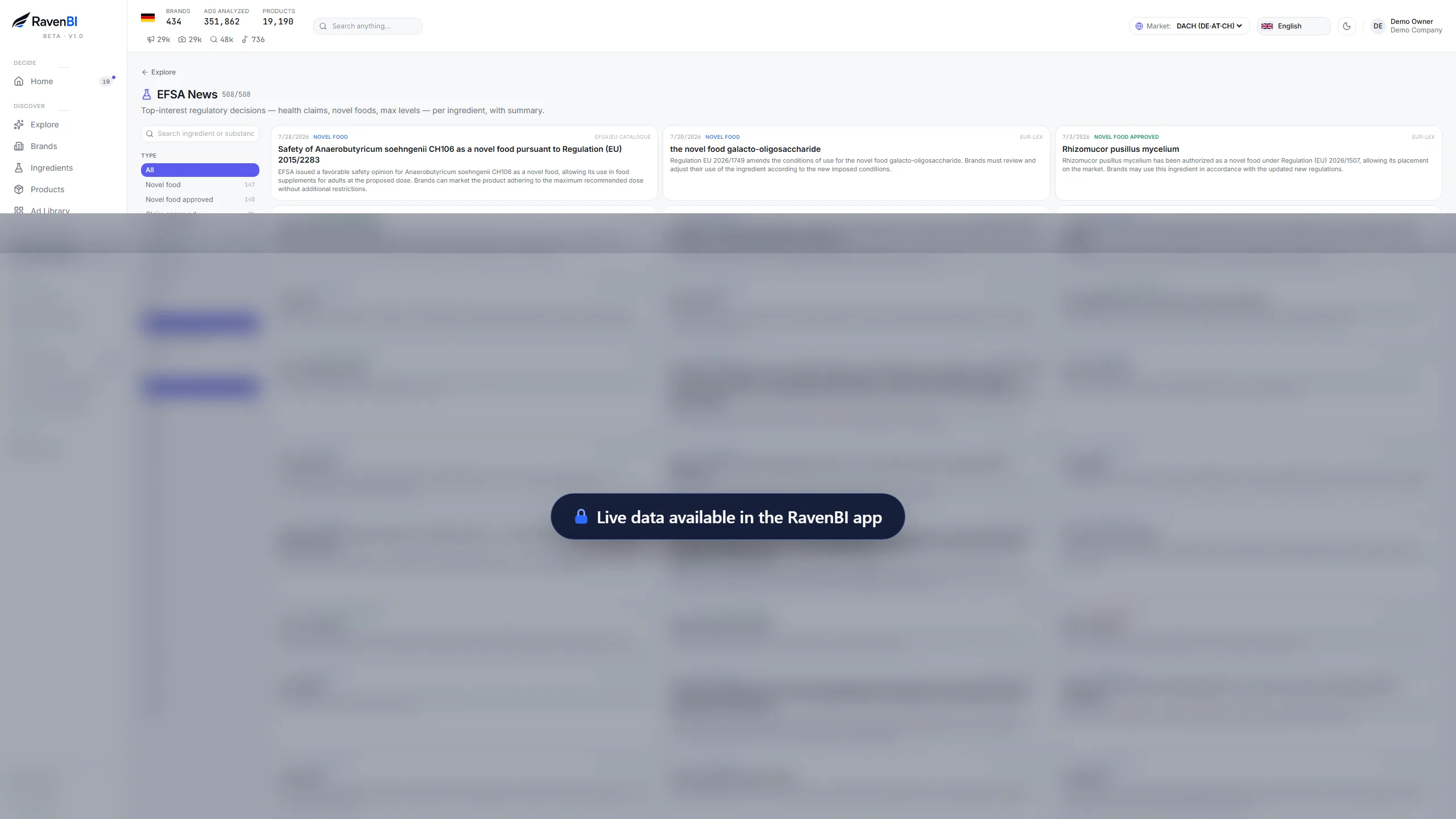
Regulatory decisions, filterable by type, source, and year — each with its summary, official source, and exposure in the tracked market.
How to read the signals
- Claim approved + high exposure = a new gate on crowded ground — the early-positioning window closes as the market adopts it; worth evaluating now, not next year.
- Claim approved + low exposure = a new gate on empty ground — combined with rising demand (the whitespace guide measures it), one of the cleanest opportunity signals there is.
- Claim refused + high exposure = a decision touching a lot of market — it's not your job to flag it to others, but it is your job not to be on that list and to know a wave of rewordings may follow.
- Novel food authorised = a new legal gate, under the decision's conditions — relatively rare (you can see the count per year directly in the radar, filtering by Type and Year) and almost always worth five minutes of reading, even if it doesn't look like your category.
The typical mistakes
- reading the radar once, during research, and never again — decisions flow all year, and the ones that matter to you can appear at any time;
- skipping the exposure section — without it every decision looks equally important, which means none does;
- treating "claim refused" as news about others — check your own wordings against it first;
- extrapolating from the summary to the label — the summary is a compass, not a legal text; the final wording goes through the official source and the specialist.
Exercise
For the three main ingredients of your product (or project), look each one up in the EFSA Radar and write down: the latest decision concerning it, its type, and the market's exposure on each. If any of the decisions surprised you — you've just proven to yourself why the radar is read periodically, not once.
The radar shows what can be said. But your hero ingredient is almost never the one entitled to say it — and here enters the construction that resolves the asymmetry: the hero that differentiates plus the carriers that promise legally. Next chapter: the carrier ingredient.