
Reports and Live Snapshot: the Report That Comes on Its Own
The pieces so far work on differences and exceptions: Home shows you what changed since your last visit, the alerts catch what can't wait. What's still missing is the view from above — the picture of the whole week, with the market seen as a whole, not as a list of events. And for a founder, exactly this view is the one that keeps getting postponed: it requires sitting down, opening, composing — so it always loses to operations.
The system's solution is to reverse the direction: you don't go to the picture, the picture comes to you. The weekly digest lands in your inbox on Monday with the synthesis ready-composed, and Reports in the app holds the complete version, with every row clickable to its source. The chapter teaches you to read the first in ten minutes and to know when the second is worth opening.
What you'll be able to do after this chapter
- read the Monday digest with a fixed method: which section answers which question;
- tell the weeks for reading from the weeks for opening the full report;
- use the Live Snapshot in the app as the market's scoreboard, with the path from row to source.
The principle
The Monday digest is built as a pyramid — top to bottom, from movement to opportunity:
- Who's moving — the week's ad accelerators (who raised their launch pace the most in 7 days, versus the prior week) and the reach gainers (the brands with the most visible exposure gains, with the due estimated spend — the same rough-estimate label from chapter 4).
- What's heating up — the accelerating ingredients and the rotation of reach and estimated spend between categories: where the visible paid attention is leaving from and where it's heading.
- Where there's room — the gaps in your market and the claim-anchored openings: the sections that link monitoring to the whitespace and claims guides.
- Your own — the brands to watch (the leaders plus the fastest accelerating) and your watchlist's section: what the ⭐ entities did this week.
The ten-minute reading follows the pyramid with one question per floor: is anyone attacking me? (floor 1, filtered on your categories), is my terrain shifting? (floor 2), has anything opened up for me? (floor 3), what did mine do? (floor 4). Four questions, four short answers — and the decision whether this week demands more.
"More" means Reports in the app: the market's updated scoreboard — brands, active ads, fresh signals, threats, open opportunities, launches — plus the AI-generated executive brief, with the top opportunity, the top threat, and the recommended action. Its golden rule is that every row opens: any figure that surprises you is one click from its source, hence verifiable, not to be taken on faith.
The workflow in RavenBI
- Monday, at the first coffee: the digest, with the pyramid method — four questions, ten minutes. What passes the questions gets noted by name: a brand, an ingredient, a gap.
- Every note gets one of two paths on the spot: it enters the weekly judgment hour (chapter 8), or — if it's burning — it gets investigated today, on its path in the app.
- When two or more floors of the pyramid gave answers that concern you, open Reports: read the executive brief, then descend on the rows that brought you here — click on each, down to the source.
- Once a month, regardless of the week, open Reports anyway: the whole scoreboard, top to bottom — the periodic calibration of your picture of the market, so the slow drift doesn't accumulate unnoticed.
- Keep the simple tally of the Monday notes: how many reached the judgment hour, how many proved relevant. It's the thermometer of the whole system — and the hygiene material for chapters 2 and 6.
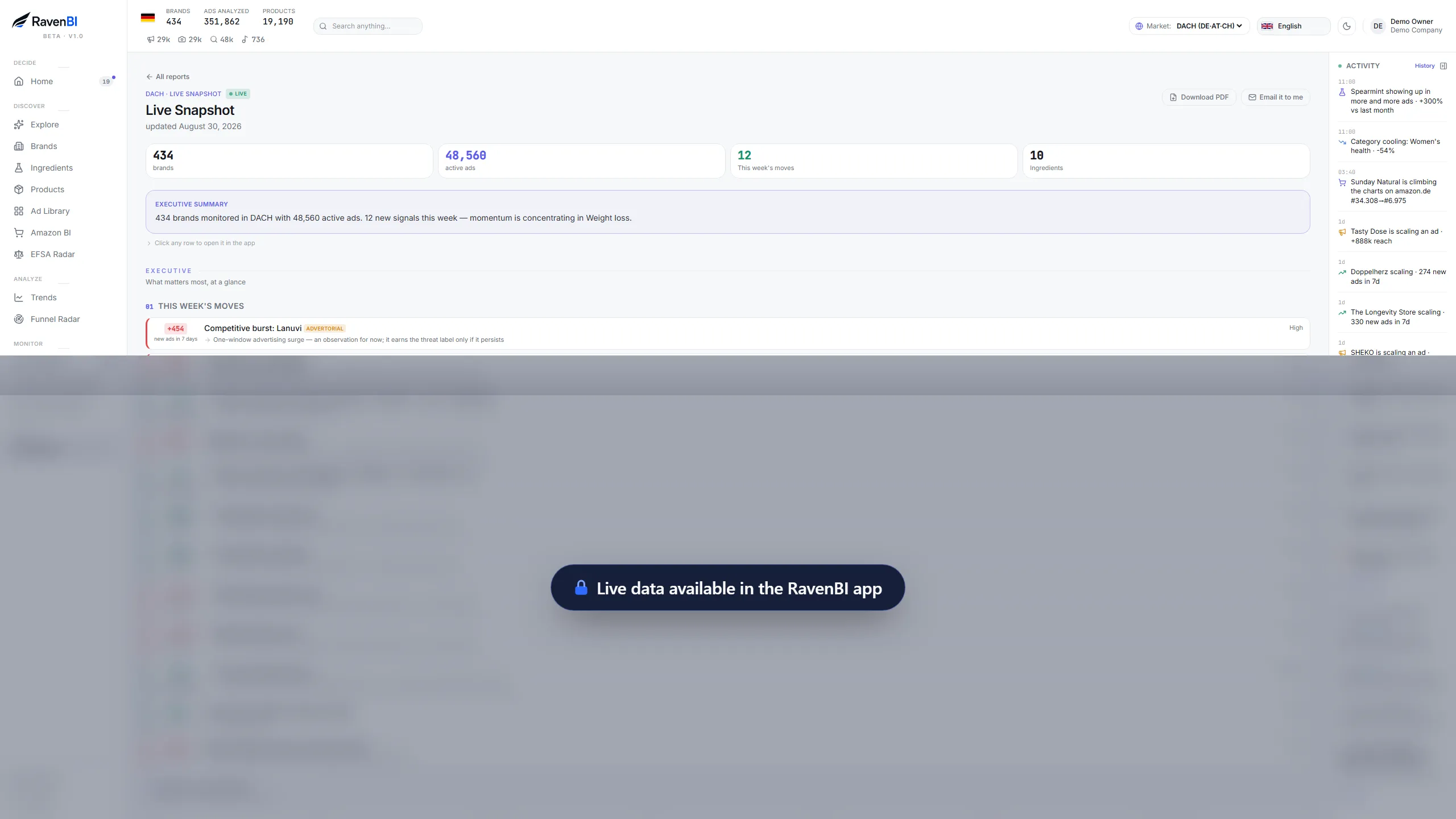
The market's tableau: the scoreboard, the active signals, and the executive brief — the complete version of the Monday digest, with every row clickable to its source.
How to read the signals
- A main rival among the week's accelerators = if it was a direct rival that passed the interruption test and you're learning it here first — review the configuration from chapter 6; otherwise, the digest did exactly its job as the slow channel;
- Your category in the reach rotation, on the outflow side = the visible paid attention is leaving your terrain — not a verdict, but the question of the week: seasonal cycle or trend?
- A new gap on your terrain in the openings section = the direct bridge to the whitespace guide — to be validated with the method there, not declared an opportunity from the digest;
- A quiet watchlist in the digest, weeks in a row = the system confirming on the slow channel what Home told you on the fast one — the coherence between channels is the sign you can rely on both.
The typical mistakes
- reading the digest like a newsletter — without the four questions, it's pleasant information that changes nothing; with them, it's triage;
- skipping the quiet weeks — ten minutes cost little, and exactly in the "quiet" weeks the slow trends accumulate;
- taking the AI's recommended action as a decision — it's a starting point for your judgment, with the sources one click away; delegating judgment was never in the contract;
- collecting Monday notes without giving them a path — a note without a destination (the judgment hour or today's investigation) is the equivalent of a tab open forever.
Exercise
Next Monday: the digest with the pyramid method, timed — four questions, four written answers, under fifteen minutes including notes. Then check the channel coherence once: compare the digest's watchlist section with what Home showed you in the same week. If they tell the same story — your system already has two channels confirming each other.
All the pieces are installed: the list, the map, the reading of moves, the differences screen, the alerts, the report. What remains is the question everything exists for: what do you do with what you learn? The last chapter: from observation to action — test, react, or ignore.