
Leaders, Fast Movers, New Entrants: the Map of Forces in Your Market
Your market isn't a list of competitors — it's a structure with three floors that move differently. At the top, the leaders: big and visible, with the weight that shifts standards — though their rhythm is read separately, because some accelerate and others cool. In the middle, the accelerating: still small, but with the pace that can bring them next to you within a season. At the bottom, the freshly entered: many won't keep their pace, but among them may also stand a future leader — at today's price of attention. ("Force" here means visibility and public activity — not sales or market share, which nobody sees.)
Whoever looks only at the leaders sees yesterday's market. Whoever looks only at the newcomers drowns in noise. The Brands page in RavenBI cuts the structure exactly along these floors — and this chapter teaches you to read each cut with its correct question.
What you'll be able to do after this chapter
- read the three views — Leaders, Fast movers, New entrants — each with its question and its visiting rhythm;
- use the columns that matter: position, momentum, growth, with their exact definitions;
- identify the "dangerous ones" — small brands with big acceleration — before they become obvious.
The principle
The Brands page comes with ready-cut views — All brands / Leaders / Fast movers / New entrants / Watched — and with three columns that make the difference between a list and a map:
- Position — the market position by active ads: Leader means top 10% of the market with at least 20 active ads; below it, Challenger, Emerging, Small. The snapshot of today's forces.
- Momentum — the launch rhythm of the last 30 days versus the prior 30: Accelerating, Stable, Cooling. Direction, not size — and exactly why it complements position instead of repeating it.
- Growth — the same comparison, in percentages. With a guard the radar sets on its own and which deserves respect: for brands under observation for less than 60 days, the launch rhythm isn't asserted yet — the history is too short for the derivative to mean anything.
The combination of the two axes is the chapter's key reading. Leader + Cooling is one story (the giant slowing down — terrain about to free up?). Small + Accelerating is another (someone seriously raising their launch pace — your future rival?). Each floor reads with its own question: at the leaders you ask what standard they set, at the fast movers where they're accelerating, at the newcomers who is still there in a quarter.
One extra instrument for point comparisons: tick up to three brands and put them side by side — channels, categories, shared and distinct ingredients, Amazon presence. And the Include networks toggle adds each brand's footprint of promoting affiliates — useful when you want the real market presence, not just their own ads.
The workflow in RavenBI
- Open Brands on your market and read the radar cards at the top first: the fastest growing, the biggest by reach, the newcomer — the market's pulse in three seconds.
- Switch to Leaders and walk the list with the floor's question: who they are, what categories they sit in, what momentum they have. A leader with Cooling gets noted — chapter 4 shows you how to read their move in detail.
- Switch to Fast movers — the most valuable floor for a founder. Look for the combination Small or Emerging + Accelerating on your categories: these are the "dangerous ones"; ⭐ the ones touching your terrain.
- Move to New entrants with calibrated expectations: many won't keep their pace. Don't study them now — note the ones in your categories and re-judge them in a quarter; whoever is still visibly active AND accelerating deserves the analysis only then.
- Pick two or three rivals to compare and put them side by side with your brand: what they have and you don't, what you have and they don't. The gaps in the comparison are work items, not just information.
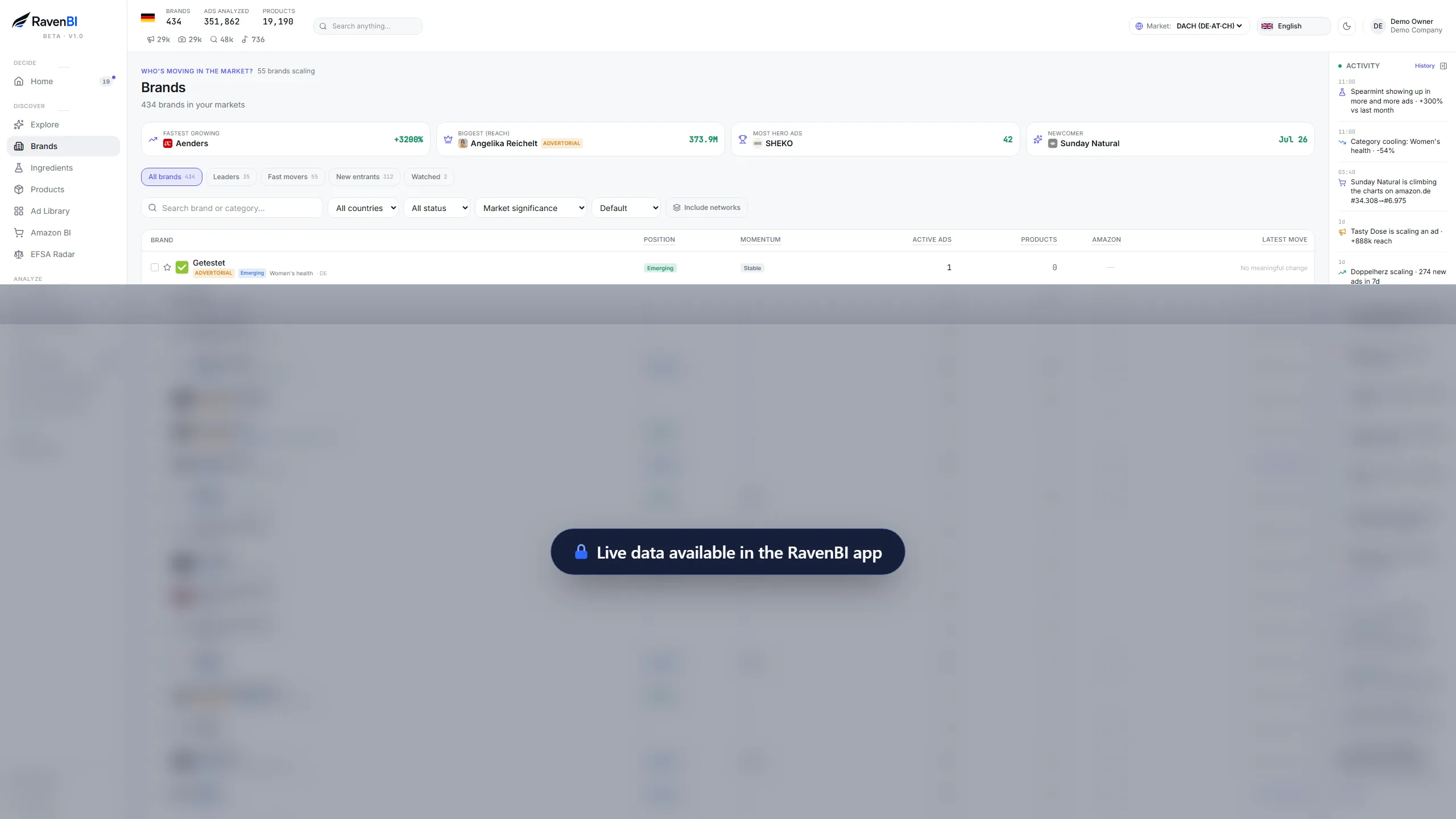
The map of forces: position, momentum, active ads, Amazon presence, and the latest move — per brand, with the Leaders / Fast movers / New entrants views ready-cut.
How to read the signals
- Leader + Accelerating = pressure on the whole market — the category's standards may shift; their funnel and offer deserve re-analysis now, not next year;
- Leader + Cooling = potential retreat or reallocation — to follow over time: if the cooling holds, terrain frees up; but remember the guard from the whitespace guide: consolidation (cutting ads, growing reach) is not retreat;
- Small + Accelerating on your category = the chapter's most actionable signal — someone is betting seriously on your terrain; ⭐ immediately and the full reading of chapter 4;
- New entrant still active and accelerating after the first quarter = passed the filter that thins the entry wave considerably — only now do they deserve the analysis that made no sense in the first month.
The typical mistakes
- reading the threat only in size — acceleration deserves separate tracking, especially at small brands; but the stable leader isn't just scenery either: the standards they set touch you even when they don't move;
- reading growth without the history guard — a brand observed for three weeks showing "+300%" is a derivative on noise, and the radar says so explicitly;
- studying every newcomer — a lot of work on entities that mostly won't keep their pace; the correct filter is sustained activity plus acceleration;
- looking at the structure only once — the floors move; these views are the piece to read on the weekly rhythm, not at the annual research.
Exercise
Write the map of forces for your market, in three short lists: the leaders of your categories (with each one's momentum), the fast movers touching your terrain (⭐ applied), and two or three newcomers to re-judge in a quarter — with the re-judgment date in your calendar. Then a single synthesis sentence: where does the most likely pressure on your position come from, today?
The map tells you who matters. The next question is what each one is doing — and for that, the radar compresses each brand's activity into a single column that deserves a whole chapter: the latest move.