
7 Best Competitive Intelligence Tools for Supplement Brands in 2026
If you sell dietary supplements, the problem is not finding another generic competitive intelligence tool. The problem is connecting ads, products, ingredients, Amazon traction and competitor moves — because launch, pricing, claim and media decisions usually need all of those signals at once, and each of them lives in a different tool.
This comparison is written by the RavenBI team, so read it with that context. We have kept the claims factual, included where other tools are strongest, and separated RavenBI's measured product data from opinion. Every number about RavenBI below was measured in the product on 24 September 2026.
Quick answer: supplement brands usually need a stack — Meta Ad Library for raw ad checks, Keepa for ASIN history, Google Trends for demand direction, Similarweb for traffic, Minea for broad e-commerce ad inspiration, traditional research for category sizing, and RavenBI when the question needs ads, products, ingredients, Amazon and regulatory context connected in one supplement-specific workflow.
What supplement brands actually need from competitive intelligence
Before comparing tools, it's worth writing down the actual jobs. In our conversations with supplement founders and growth teams, the same six keep coming back:
- Ads visibility — who is advertising what, with which claims, formats and hooks, and which of those ads keep running for months (the closest public signal to "this works").
- Amazon reality — ranks, reviews and observed sales movement on marketplaces that matter heavily for European supplement discovery and conversion.
- Product tracking — competitor portfolios, launches, formats and pricing, not just their marketing.
- Ingredient intelligence — which ingredients are gaining demand, which are saturated, and what the regulatory status allows you to say about them.
- Funnel visibility — what happens after the click: landing-page angle, offer structure, bundles, subscriptions, guarantees and checkout mechanics.
- Supplement-specific context — EFSA claims, novel food status, dosage norms. A generic tool can't tell you that a trending ingredient is unauthorised as a novel food.
Most horizontal tools are not built around ingredients or supplement regulation — yet those two areas often shape launch, claims and positioning decisions.
Supplement competitive intelligence tools compared
These are not perfect one-for-one substitutes; they are the tools supplement teams most often combine when trying to understand competitors, demand, ads and Amazon movement.
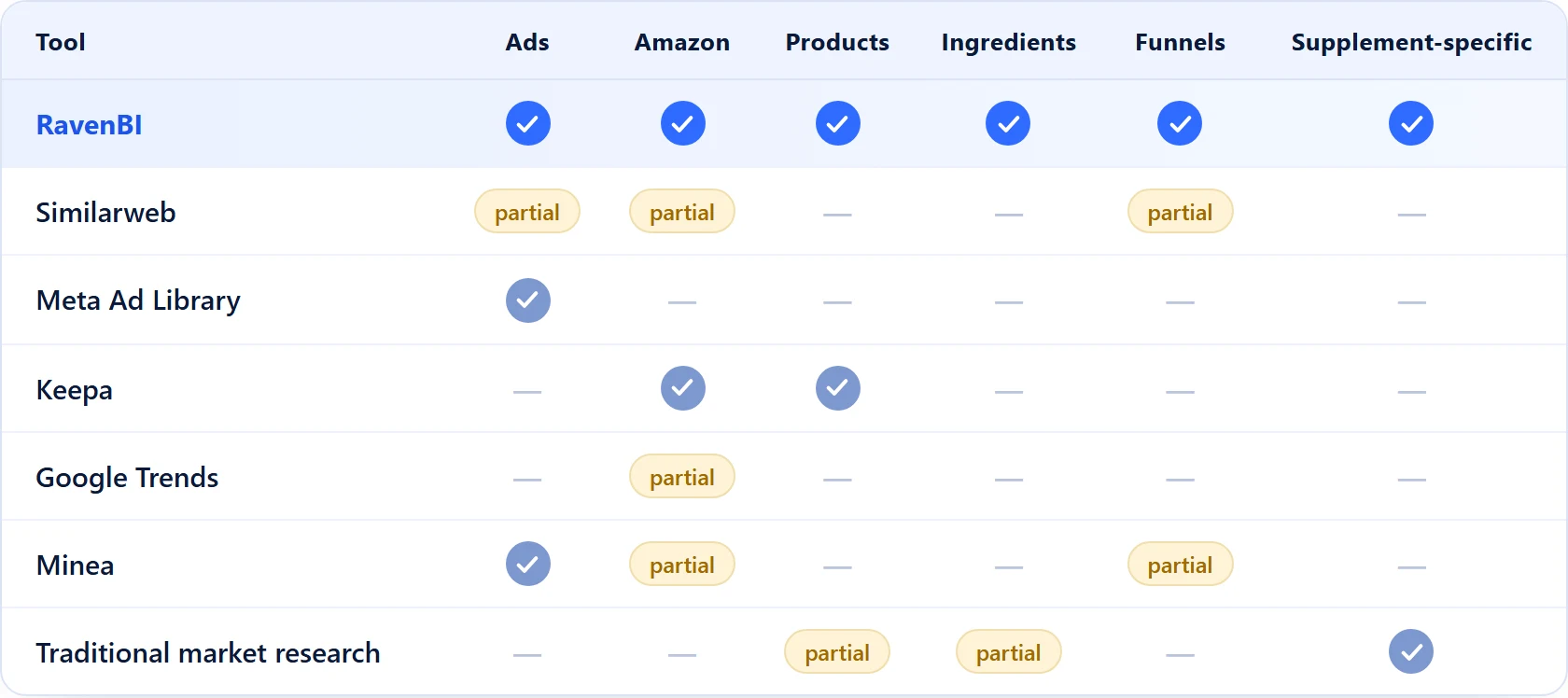
"Partial" is doing honest work in that table: Similarweb sees traffic to Amazon but not ranks or sales movement; Minea tracks ads across several networks and surfaces winning products, but without a supplement lens; Google Trends reads search interest for anything, but that's demand only. Details below.
1. RavenBI — the supplement-specific radar
What it is: a market intelligence platform built only for the supplement industry. The radar currently follows over 2,600 supplement brands across nine countries (DACH, UK, France, Italy, Spain, Romania, US), with more than 2 million ads captured and around 375,000 ad creatives active right now, connected to 200,000+ tracked products, an ingredient layer with search demand and advertising pressure per ingredient, over 110,000 Amazon listings on six marketplaces with 13 million+ rank and price snapshots, and a regulatory layer with 6,700+ tracked claim decisions, plus novel-food status and maximum-level context per ingredient. These are observed public and licensed data signals — not claimed competitor revenue, budgets or profit, which nobody outside a company sees.
What makes it different: the connection between layers. An ad links to a product, the product to its ingredients, the ingredients to demand curves, Amazon movement and authorised claims. Instead of exporting three CSVs and reconciling brand, product and ingredient names by hand, you can ask "who is pushing collagen, is demand still growing, and what claims are authorised or risky?" in one workflow. Where Amazon displays "bought in past month" figures, RavenBI treats them as observed Amazon signals, not modelled sales estimates.
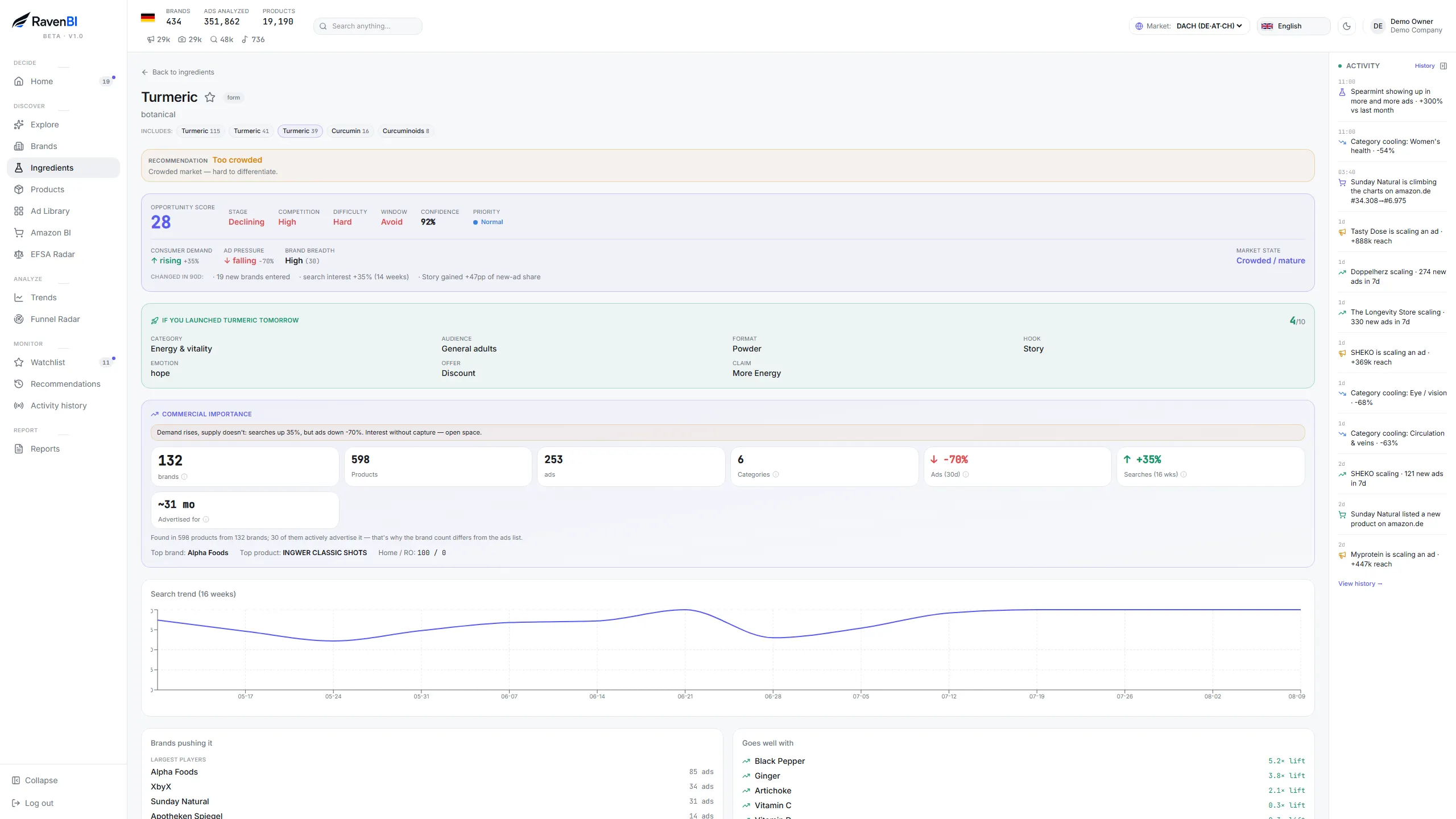
The connection in one place: demand vs ad pressure, competition, window and claim context — an ingredient's full signal on a single page.
What it doesn't do: it only covers supplements — if you also sell cosmetics or pet food, the radar won't follow those categories. It works with public signals, and says so explicitly. Market coverage is the nine countries above, not worldwide.
Pricing: from €119/month, cancel monthly. See plans & pricing
2. Similarweb — traffic intelligence, not market intelligence
What it does well: website traffic estimates, traffic sources, audience overlap, keyword intelligence. If you want to know how big a competitor's site is and where its visitors come from, this is the reference tool.
Where it stops for a supplement brand: it sees traffic, not market. No product-level tracking, no ingredient layer, no claim context — and its ad intelligence is stronger for traffic and display visibility than for the paid-social creative monitoring many supplement growth teams need. For funnels you'll see which pages get traffic, not what the offer or checkout does. As with traffic-estimation tools generally, smaller sites should be read directionally rather than as exact numbers.
Use it when: you need traffic benchmarks or channel mix for larger competitors.
3. Meta Ad Library — free, official, and raw
What it does well: it's the official public archive of ads running on Facebook and Instagram, free, with EU reach data under the DSA. Searching a competitor by name and reading their current ads costs nothing.
Where it stops: it's a lookup tool, not a monitoring system. Limited historical workflow, no market-level aggregation ("which magnesium brands accelerated this month?"), no product or ingredient linkage, no alerts — and topic-based research is limited compared with advertiser lookup. You can see one brand's ads today; you cannot see a market.
Use it when: you want to spot-check a specific competitor's active ads by hand — or verify what any paid tool claims about them. (Our supplement ads playbook is built on exactly this kind of public signal, read systematically.)
4. Keepa — the Amazon reference
What it does well: price and sales-rank history for individual Amazon products, tracked deeply and cheaply. For a single ASIN's history, it is one of the strongest specialist tools available.
Where it stops: it answers Amazon questions, not broader market questions. No ads, no funnels, no ingredient or claim layer, and product discovery is ASIN-by-ASIN — it answers "what happened to this product?" not "what's happening in this market?". You also need to already know which products matter.
Use it when: you live on Amazon and need deep per-product history. (RavenBI's Amazon layer is itself built on licensed Amazon data of this kind — connected to the brands, ads and ingredients the rest of the radar tracks.)
5. Google Trends — demand direction, nothing else
What it does well: free, reliable direction of search interest for almost any term, in any country, over any period. Every demand check should start here.
Where it stops: an index, not a number; no competitive layer at all — it tells you interest in ashwagandha is flat in Germany, not who's advertising it, what they charge, or whether Amazon sales agree. Single-keyword views also mislead: "magnesium" tells you nothing about which form (bisglycinate vs citrate) is moving.
Use it when: validating demand direction for a shortlist you already have. In RavenBI, this signal is built in per ingredient — search demand sits directly next to advertising pressure, which is exactly the pair that finds white space.
6. Minea — ad spy for e-commerce generalists
What it does well: a large cross-network ad library (Facebook, TikTok, Pinterest) with engagement-based filters, plus shop and product spying — built for dropshippers and e-com operators hunting winning products across all niches.
Where it stops for supplements: no supplement lens. No ingredient layer, no Amazon rank reality, no supplement-specific claim or regulatory context — and its winning-product workflows are designed for broad e-commerce discovery rather than a regulated category where trust, repeat purchase and compliant claims matter.
Use it when: you sell across many product categories and want broad creative inspiration.
7. Traditional market research — Innova, Mintel, Euromonitor and friends
What it does well: rigorous consumer surveys, category sizing, multi-year forecasts, written by analysts. For board decks and category strategy, this is the standard.
Where it stops: cadence and altitude. Reports are annual or quarterly, cost thousands of euros, and describe categories, not competitors — you'll learn that "cognitive health is growing", not that a competitor doubled its ad output for a nootropic stack three weeks ago. For fast-moving advertising and competitor monitoring, the reporting cadence is usually too slow to act as an operating dashboard.
Use it when: you need defensible category sizing for investors or long-range planning.
Who should choose RavenBI?
- Supplement founders deciding what to launch next — the ingredient layer connects demand, advertising pressure, white-space formulas and claim availability in a supplement-specific workflow.
- Heads of Growth who need to know what competitors run, which of their ads survive months, and what changed this week — without manually stalking ad libraries. (That workflow is documented step by step in our competitive monitoring guide.)
- E-commerce teams balancing Meta and Amazon — the "traction without ad pressure" view connects two signals that are usually split across separate tools.
- Product innovation teams — formula ideas checked against market signals, ingredient momentum across independent sources, and regulatory status attached.
If you're not in supplements, RavenBI is the wrong tool — pick Similarweb for traffic, Minea for broad ad spying, Keepa for Amazon. That's the honest trade: horizontal breadth against vertical depth.
See your supplement market in RavenBI — ads, products, ingredients and Amazon movement connected in one place. See plans & pricing
Which competitor research tool should a supplement brand start with?
| If your question is… | Start with |
|---|---|
| "How big is their website?" | Similarweb |
| "What ads does brand X run right now?" | Meta Ad Library |
| "What happened to this ASIN?" | Keepa |
| "Is interest in X growing?" | Google Trends |
| "What's a winning product to drop-ship?" | Minea |
| "How big is the category in 2030?" | Traditional research |
| "What should my supplement brand do next?" | RavenBI |
Track supplement competitors, products, ads and Amazon movement in one place — built only for supplements, updated daily.
RavenBI PRO watches the supplement market for you — every ad, every funnel, every trend. From €149/month, cancel anytime.
See plans & pricing