
We analysed over 100,000 supplement ads. Here's what the market-leading brands have in common.
The longest-running ads aren't always the most creative ones. They're the ones that repeat the same marketing principles — over and over again.
The starting point
If you've spent time in the Meta Ad Library (formerly Facebook Ads Library), you've probably noticed two things:
- there are thousands of active ads;
- it's almost impossible to tell which of them are worth studying.
An ad can look spectacular and disappear within a week. Another can seem ordinary — and still run for months, in more and more variants, for the simple reason that the brand has good reasons to keep it alive.
This article started with the analysis of over 100,000 supplement ads. Since then, the RavenBI database has passed 2 million captured ads from over 2,700 brands in twelve countries — more than 350,000 of them in the DACH market alone (figures measured on 1 October 2026). The conclusion hasn't changed: the winners don't reinvent marketing. They repeat the same patterns.
But here's the trap: the generic patterns are free in any marketing article — including this one. What you won't find in any article is the specific answer for your category: which problems your competitors are attacking right now, which hooks they repeat, which offers they kept after testing. That's the answer that's worth money — and it changes from market to market.
So in the updated version of this article, we don't give you lists to copy. We show you, pattern by pattern, how to find the answer for your own market in RavenBI.
1. They don't sell the ingredient. They sell the problem the customer feels.
Strong brands rarely open an ad with the ingredient list. They open with a problem the customer recognises instantly — the ingredients come later, as justification.
The useful question is not "which problem should I use in my copy?". It's: which problems are my competitors already attacking — and on which of them do they keep running old, active, scaled ads?
How to find the answer in RavenBI: open the Ad Library, pick your market and category, then use the Problem facet. You see the real distribution of ads across problems — which theme gathers thousands of ads and which is nearly empty. Then don't stop at the total: open the active ads on a problem, look at their age and estimated reach. The difference between "a popular problem" and "a problem competitors have been pushing consistently for months" shows up exactly there.
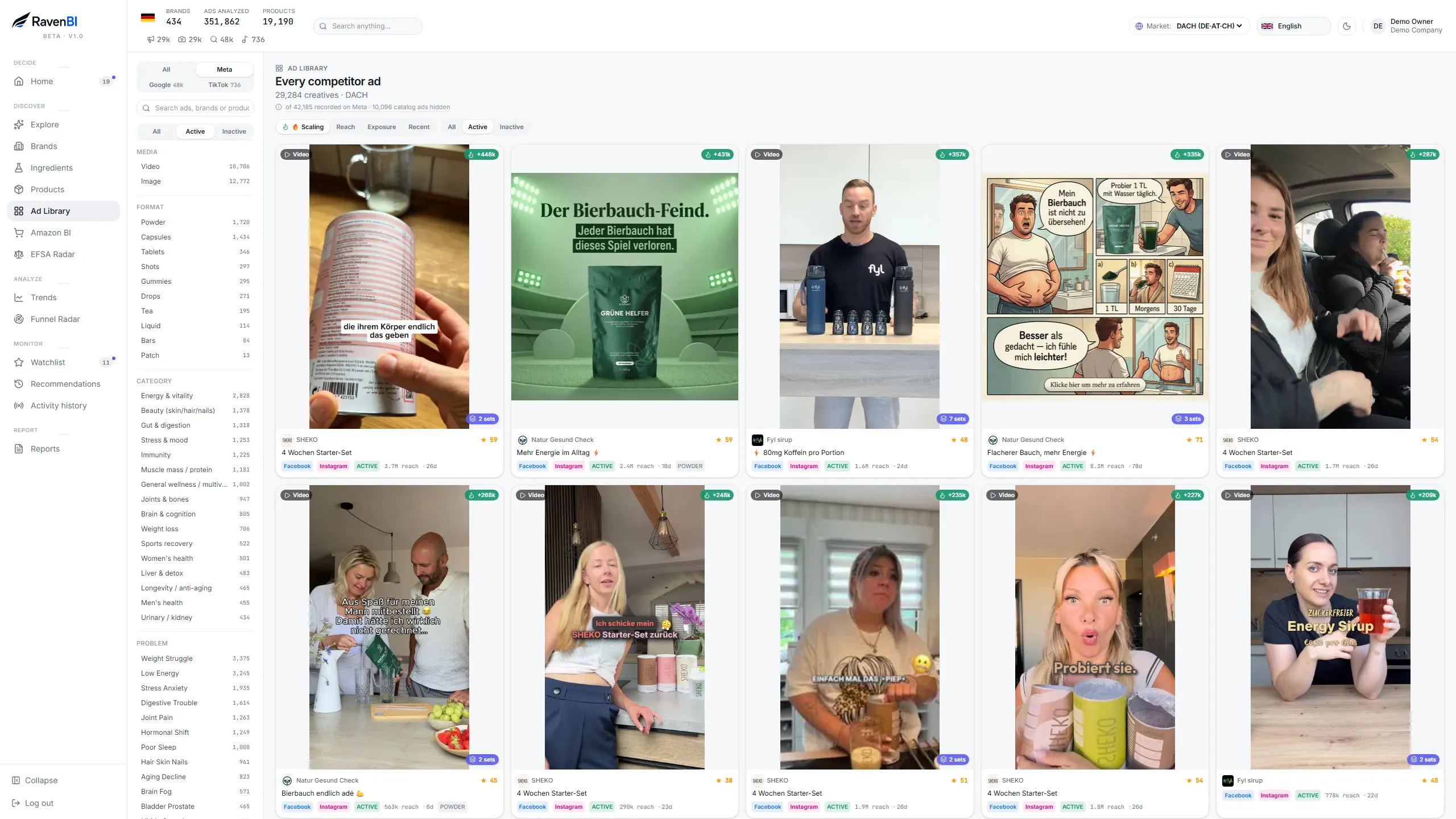
The Problem facet in the Ad Library: how many ads attack each problem in your market — and which of them have been active for months.
2. The first three seconds decide everything
With video ads, attention is won or lost extremely fast. The hook is the entry into the message — and there's no universal hook for supplements. There are hooks that repeat in your category, and hooks that die after a few tests.
How to find the answer in RavenBI: every ad is classified automatically, and Explore has dedicated pages per hook — open one and you see every ad in the market using that angle of attention. The reading rule: a hook that shows up in many new ads may just be a fashion; a hook that shows up in old, active, high-reach ads is a much more serious signal. That's the difference between creative noise and a repeated pattern — and it's visible right in the list.
3. Emotion beats logic
Two ads can promise the same result while activating completely different emotions. That's why it's not enough to see what the ad says — you need to see what psychological tension the funnel behind it uses.
How to find the answer in RavenBI: open the funnel in the Funnel Radar and look at the Psychology section: the detected primary emotion, the trust elements, the urgency, the hooks and the selling angles. Then open two or three more funnels from the same category and compare. If the long-running ads all lead to funnels built on the same emotional tension, you've found a pattern of your category — not a copywriter's preference.
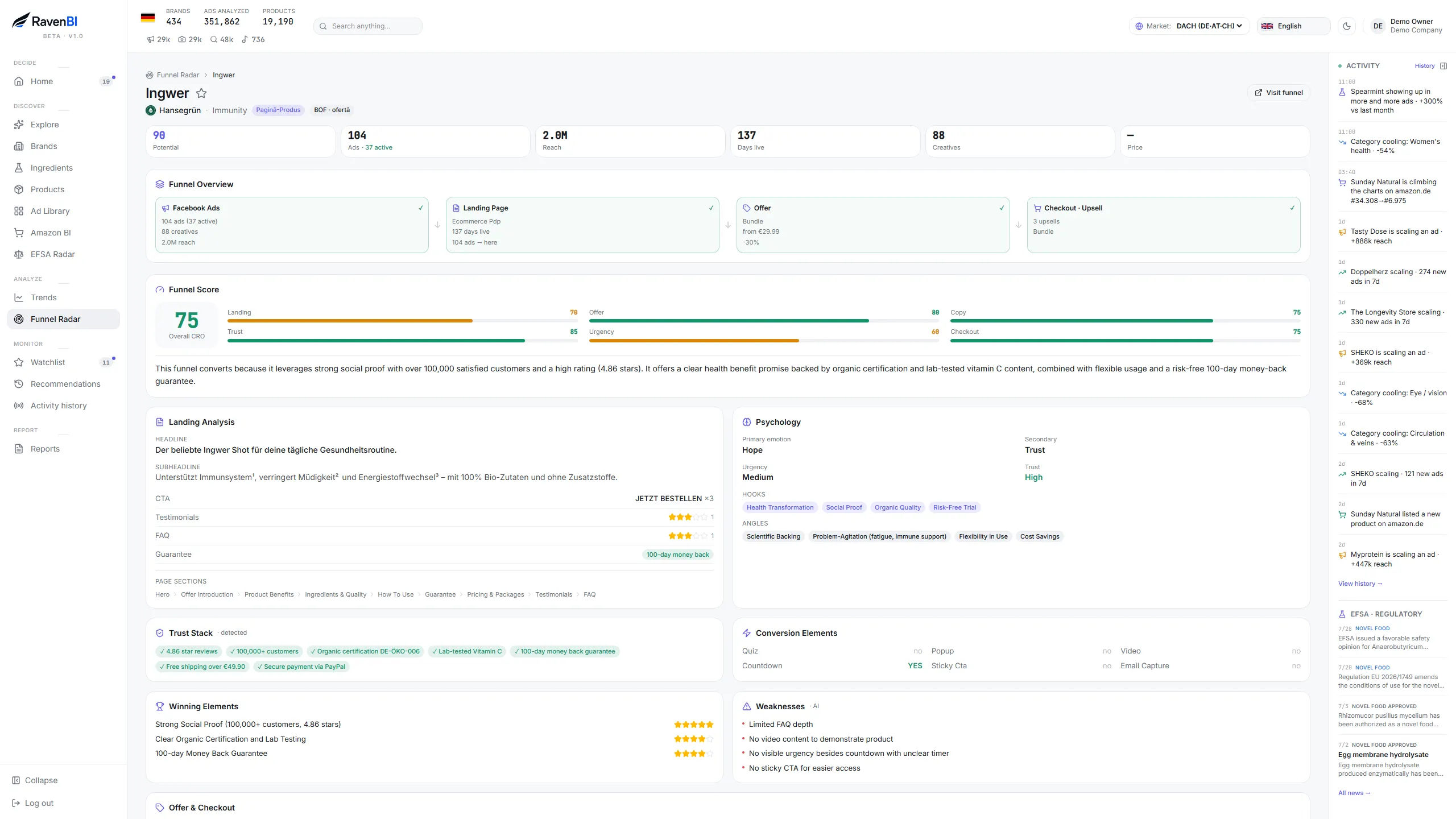
Funnel Radar: the funnel score broken down by component, and in the Psychology section — the primary emotion, trust, urgency, hooks and detected angles.
4. Proof matters more than promises
The promise wins attention. The proof reduces perceived risk — and in supplements, perceived risk is high.
The useful question is not "should I have testimonials?". It's: which set of proof is already the standard in my category — and where can I build more trust than my competitors?
How to find the answer in RavenBI: in the Funnel Radar, the Trust Stack section shows the trust elements detected on each landing page — reviews, certifications, guarantees, shipping terms — and next to it, the market comparison: what percentage of the category's funnels use each element. Right there, Weaknesses shows what the competitor's page is missing — which is exactly where you can build more than they did.
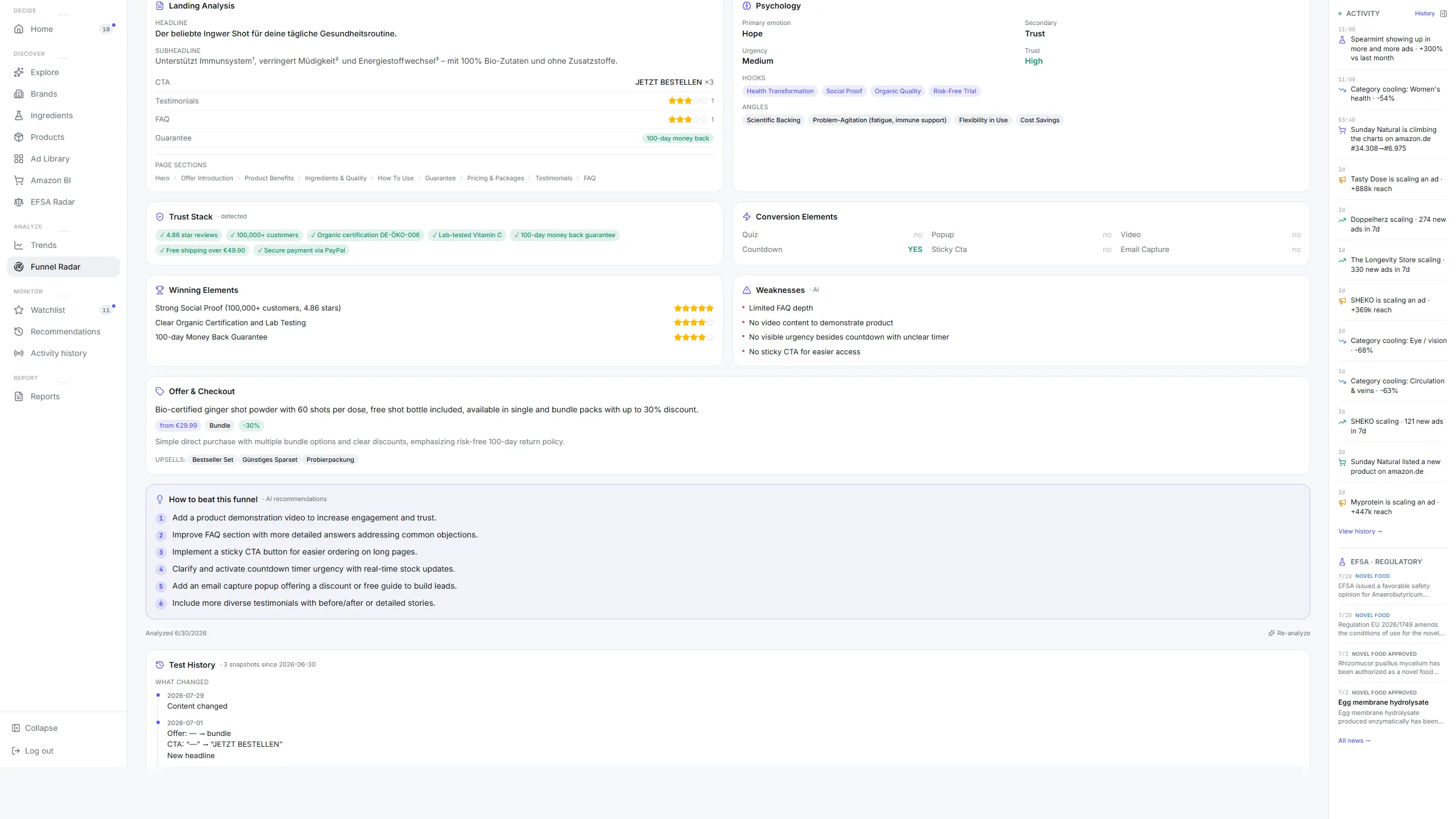
The detected Trust Stack, the weaknesses and the "How to beat this funnel" list — the competitor's proof, weighed piece by piece.
Compliance note: before–after images and aggressive visual claims can violate advertising platform policies — Meta forbids them in the personal health category — and are legally risky in the EU. RavenBI shows you what exists in the market; that doesn't turn every execution you see there into a safe practice to copy.
5. The offers are simple
An offer has to be understood in a few seconds. But there's no universal mechanic: price, bundle, discount and guarantee are judged in the context of the category.
How to find the answer in RavenBI: on each funnel's page, the Offer & Checkout area shows the price, the discount, the bundle and the upsells, and the page's history shows when the brand changed the offer — what it tested and what it kept. And in Explore, the Contrarian price signals surface products positioned far from the category's price median whose ads keep holding anyway. You're not looking for the "perfect" offer — you're looking for what competitors test, what they keep after testing, and where room for differentiation remains.
6. The landing page continues the story
One of the most expensive mistakes is the break between the ad and the page the customer lands on after the click: a different promise, a different tone, a different offer. The visitor feels like they've arrived at a different shop.
How to find the answer in RavenBI: every funnel has the Ads driving this funnel section — the ads leading to it — right next to the Landing Analysis: headline, CTA, the page's sections in order. You see them together, not separately: you can check whether the ad's hook continues into the headline and whether the page's offer supports the ad's promise. On funnels that have been running unchanged for months, fed by long-running ads, this thread is almost always unbroken — and it's instructive to see it on real cases from your category.
7. They don't replace the ads that work
Growing brands don't swap their creatives every week. If an ad does its job, it runs for months. Longevity is one of the most honest public signals: it's unlikely a brand keeps an ad alive for months, in several variants, without a good reason.
How to find the answer in RavenBI: in the Ad Library, every ad shows its age in days, its status, its estimated reach and how many variants run in parallel, and the default sort combines exactly longevity with reach. The Scaling filter narrows the list to ads with recent acceleration signals. RavenBI doesn't see a competitor's internal sales — but an ad active for 90 days, in seven variants, with growing reach, is the best starting point public data can give you.
8. Test constantly — but scale selectively
Around a long-running ad you often see the traces of testing: variants launched, kept or stopped. The difference between a brand that guesses and one that learns is the testing rhythm — and the discipline of scaling only what passed the test.
How to find the answer in RavenBI: the number of variants on each card in the Ad Library shows how broadly a brand tests a message. A funnel's Test History shows what the brand changed on the page over time — a new offer, a new headline, a new price — and what it kept. And the Brands page shows, per brand, momentum and the latest move: who's accelerating, who's pulling back, who launched a wave of new ads in the last 30 days.
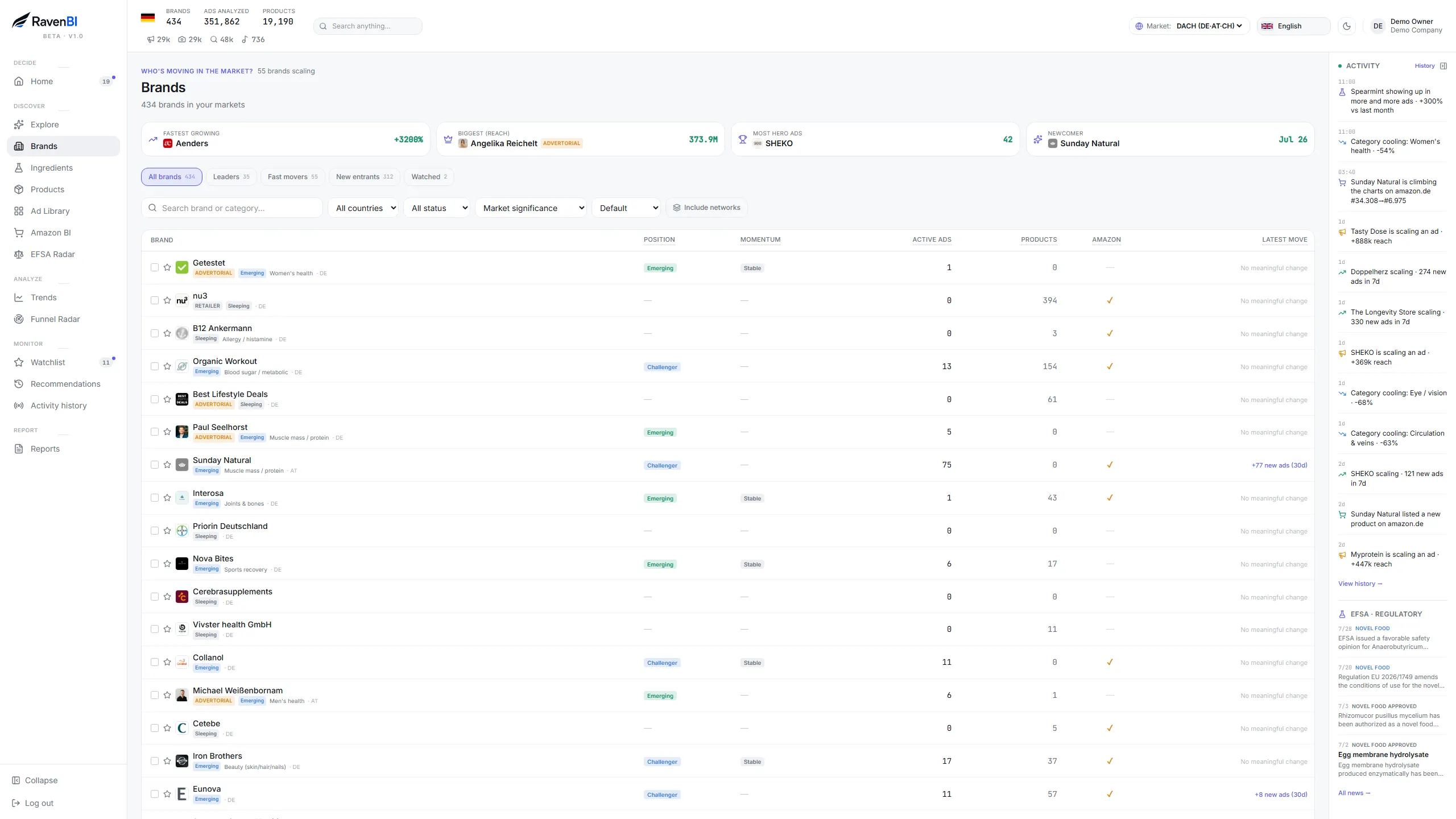
The Brands page: who's testing, who's scaling, who stopped — your competitors' moves, at a glance.
You don't need another list of hooks
The principles in this article are the easy part — and they're free: sell the result, open with a clear hook, support the promise with proof, keep the thread between ad and page, test a lot and scale a little.
The valuable part isn't the principle. It's its version in your category, now: which problems your competitors attack, which angles they repeat, which offers they kept after testing, which funnels haven't changed in months and which ads refuse to die.
In RavenBI you start from the market, category or brand you care about and follow the whole thread: ad → hook → problem → funnel → proof → offer → test history → the brand's recent moves.
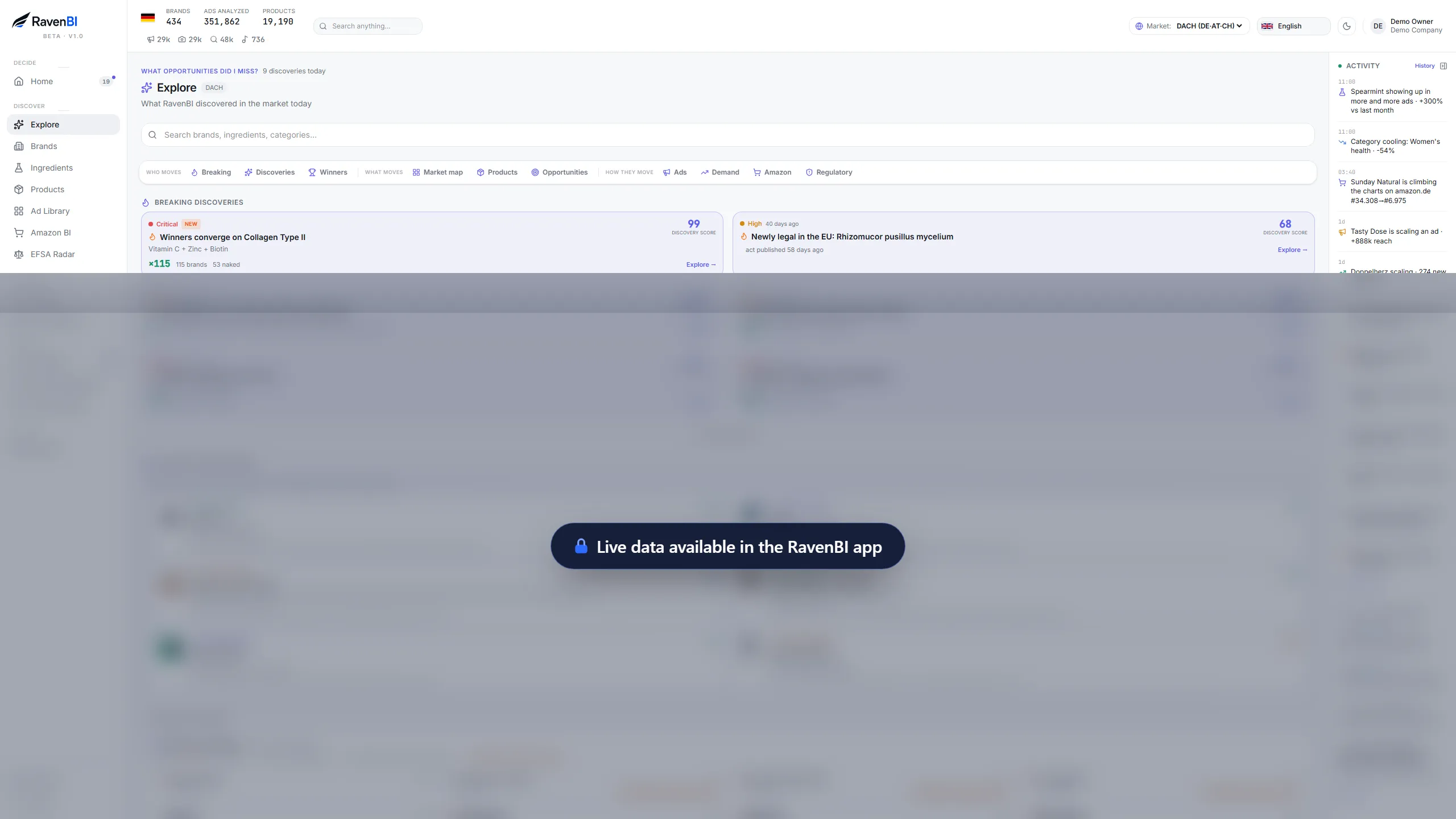
Explore: what RavenBI discovered in the market today — the starting point when you don't yet know where to look.
Don't copy the market. Understand it before you test.
Conclusion
Strong marketing doesn't mean constantly inventing something completely new. It means noticing faster what repeats, what changes and what lasts — and testing informed, not blind.
In an industry where every decision locks up thousands or tens of thousands of euros, the difference isn't made by another list of principles. It's made by seeing with your own eyes what your competitors are running in the market right now.
The best marketers don't guess. They observe, compare — and only then test.
RavenBI PRO watches the supplement market for you — every ad, every funnel, every trend. From €149/month, cancel anytime.
See plans & pricing